
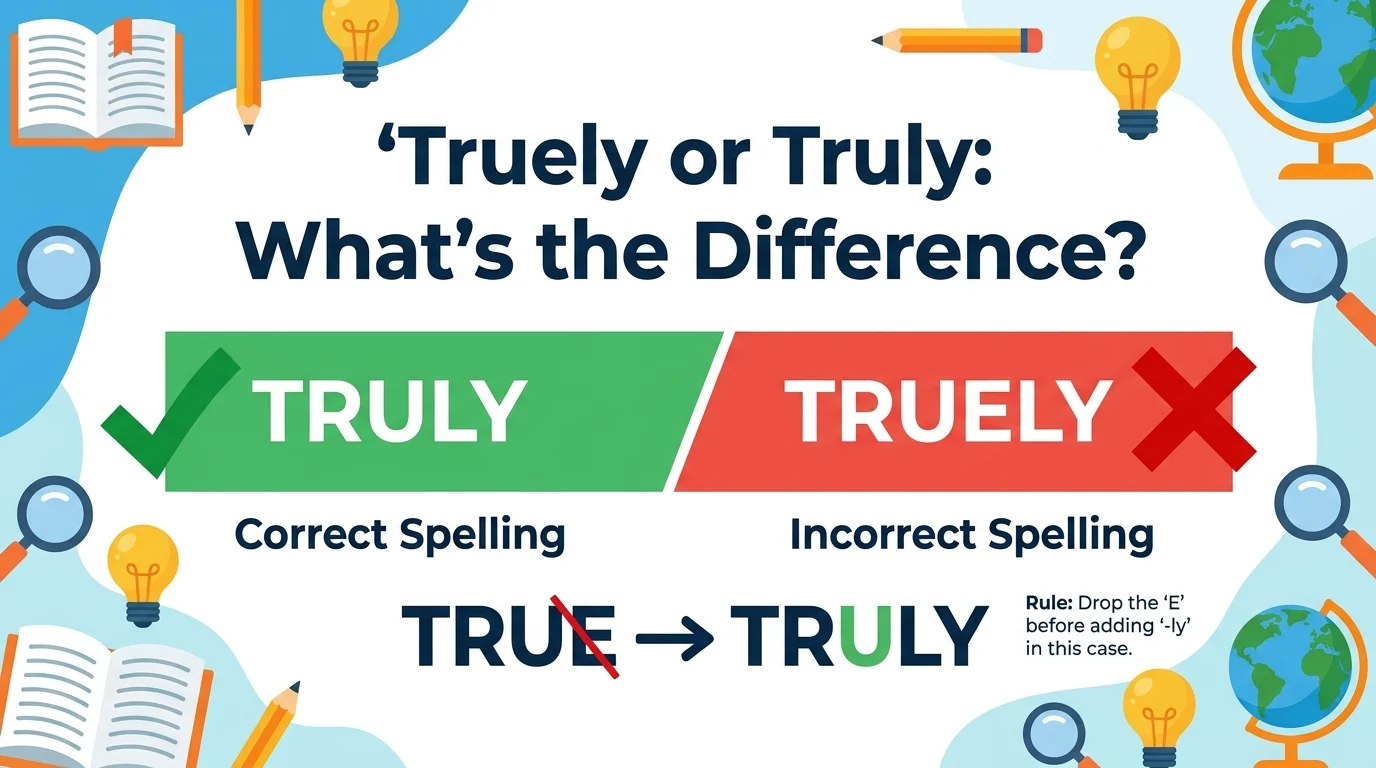
Quick Ans: “Truly” is the correct spelling. “Truely” is a common spelling mistake. Truly is an adverb that means genuinely, really, or sincerely. The confusion happens because many English words keep the letter “e” before “ly,” but “true” changes to “truly” by dropping the final “e.”
Are you confused about whether to write “truely or truly”? The correct spelling is truly.
This is a common spelling mistake because the adjective “true” ends with the letter “e.” When you add the suffix “ly,” it may seem natural to write “truely.” However, English spelling follows a different pattern here.
The correct word is “truly,” not “truely.” You can use it when you want to say that something is genuinely or sincerely true. For example, “I truly appreciate your help” means “I sincerely appreciate your help.”
Knowing this spelling difference can make your writing cleaner and more professional. The word appears often in emails, essays, conversations, reviews, and personal messages. Fortunately, the rule is easy to remember once you understand how “true” changes when it becomes an adverb.
Quick Answer and Key Takeaway
| Word | Correct? | Meaning | Example |
|---|---|---|---|
| Truly | Yes | Genuinely or sincerely | I truly enjoyed it. |
| Truely | No | Common spelling mistake | I truely enjoyed it. |
Quick rule: The correct spelling is truly. Drop the final “e” from “true” before adding “ly.”
Definition and Explanation
Truly
“Truly” is an adverb. It means genuinely, really, sincerely, or honestly.
Example: She truly cares about her students.
It can also add emphasis to a statement.
Example: This is truly amazing.
Truely
“Truely” is not the standard spelling. Writers often create this mistake because they apply a common pattern incorrectly.
For example, many adjectives keep their final “e” when forming an adverb:
polite → politely
complete → completely
However, “true” is different:
true → truly
| Adjective | Correct Adverb | Incorrect Form |
|---|---|---|
| True | Truly | Truely |
| Complete | Completely | Completeley |
| Polite | Politely | Politeley |
The main point is simple: true becomes truly, not truely.
Is This a Grammar, Usage, or Spelling Issue?
This is mainly a spelling issue.
“Truly” is the adverbial form of “true,” and it modifies verbs, adjectives, or entire statements.
Example: I truly believe you.
Here, “truly” modifies the verb “believe.”
It can also emphasize an adjective.
Example: She is truly talented.
Because “truely” is a misspelling, you should avoid it in formal and informal writing.
Real World Usage Examples
Workplace Examples
“I truly appreciate your support.”
The word “truly” shows sincere appreciation.
“We are truly grateful for your feedback.”
Recap: “Truly” can make professional messages sound sincere and appreciative.
Academic Examples
“The results truly demonstrate the importance of the study.”
Here, “truly” emphasizes the writer’s statement.
“The theory is truly significant.”
Recap: Use “truly” to add emphasis when the evidence supports your statement.
Everyday Examples
“I truly missed you.”
“She truly loves that movie.”
“I truly don’t understand what happened.”
Recap: “Truly” is common in everyday speech and writing when you want to express sincerity or emphasis.
Regional or Global Usage Differences
There is no major spelling difference between American and British English. Truly is the standard spelling in both.
English speakers around the world use “truly” to mean genuinely, sincerely, or really.
The incorrect form “truely” may appear online, but it remains a spelling mistake rather than a regional variation.
When NOT to Use It
Do not write “truely” in formal or informal English. Use “truly.”
Do not assume that every word ending in “e” keeps the “e” before “ly.”
Avoid using “truly” repeatedly in the same paragraph because it can make your writing sound exaggerated.
Do not use “truly” when you simply need the adjective “true.”
For example, say “The statement is true,” not “The statement is truly.”
Use “truly” when you need an adverb.
Common Mistakes and Corrections
| Correct Sentence | Incorrect Sentence | Why |
|---|---|---|
| I truly appreciate your help. | I truely appreciate your help. | “Truly” is the correct spelling. |
| She is truly happy. | She is truely happy. | Drop the final “e” from “true.” |
| He truly believes her. | He truely believes her. | “Truly” is the correct adverb. |
| The story is true. | The story is truly. | “True” is the adjective needed here. |
Decision Rule: If you mean “genuinely,” “really,” or “sincerely,” write truly.
Exercises With Answers
Choose the correct word.
- I _____ enjoyed the concert.
- She _____ cares about her work.
- Is this story _____?
- He _____ believes that idea.
- I am _____ grateful for your help.
- Which spelling is correct: truely or truly?
Answer Key
- truly
- truly
- true
- truly
- truly
- truly
Related Concepts and Comparisons
Readers may also search for true vs truly, truly meaning, truly definition, true adverb form, commonly misspelled words, adjective to adverb rules, words ending in ly, and English spelling rules.
FAQs
Is truely or truly correct?
“Truly” is correct. “Truely” is a common spelling mistake and should not be used in standard English.
Why is truly spelled without an e?
“True” drops its final “e” when it becomes the adverb “truly.” Therefore, “truely” is incorrect.
What does truly mean?
“Truly” means genuinely, sincerely, honestly, or really. For example, “I truly appreciate your help” expresses sincere appreciation.
Is truly a real word?
Yes. “Truly” is a standard English adverb. It is widely used in both formal and everyday writing.
What is the difference between true and truly?
“True” is usually an adjective, while “truly” is an adverb. You can say “The statement is true” and “I truly believe the statement.”
How do you remember the spelling of truly?
Remember the simple pattern “true → truly.” The final “e” disappears before “ly” is added.
Is truly formal English?
Yes. “Truly” is acceptable in formal, academic, professional, and casual writing. Its exact tone depends on the sentence.
Can truly mean really?
Yes. “Truly” can mean “really” when it adds emphasis. For example, “That was truly impressive” means “That was really impressive.”
Conclusion
When choosing between “truely or truly,” always choose truly. “Truely” is a common spelling mistake, while “truly” is the correct adverb formed from “true.”
The word “truly” means genuinely, sincerely, honestly, or really. You can use it to express strong feelings or emphasize a statement. For example, “I truly appreciate your help” shows sincere appreciation.
The spelling becomes easier when you remember one simple change. The adjective “true” loses its final “e” when it becomes “truly.” Therefore, write “true → truly,” not “true → truely.”
This spelling rule applies consistently across major varieties of English. Whether you’re writing an email, school assignment, article, or personal message, “truly” is the form you should use.
Practical tip: whenever you hesitate between “truely” and “truly,” remember that true drops the e before ly. That quick rule will help you spell the word correctly every time.
1 thought on “Truely or Truly: What’s the Difference? Easy Rules, Examples & Tips”