
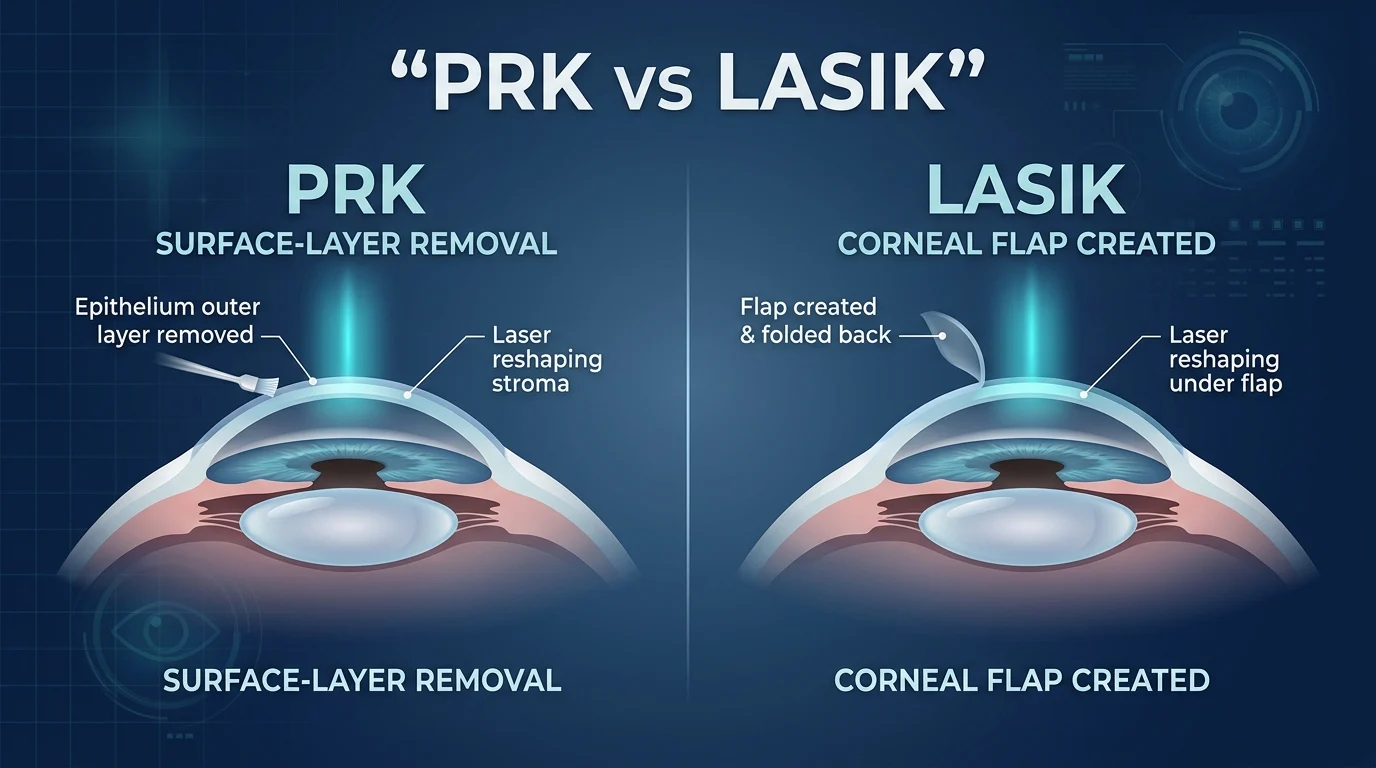
Quick Answer: PRK vs LASIK comes down to how the surgeon treats the cornea and how quickly your eyes recover. LASIK creates a thin corneal flap and usually offers faster visual recovery. PRK removes the outer layer of the cornea without creating a flap, so healing takes longer. Your eye health, corneal thickness, lifestyle, and medical history help determine the better option.
If you want to reduce your dependence on glasses or contact lenses, laser eye surgery may be worth considering. Two common options are PRK and LASIK. Both reshape the cornea to help light focus correctly on the retina, improving vision problems such as nearsightedness, farsightedness, and astigmatism.
However, these procedures differ in how they treat the cornea. LASIK usually allows patients to return to normal activities sooner, while PRK avoids creating a corneal flap. As a result, PRK may suit people whose corneas are too thin for LASIK or who participate in activities involving physical contact.
So, which procedure should you choose? The answer depends on your eyes, recovery expectations, and personal needs. Understanding the differences can help you discuss the available options with a qualified eye surgeon.
What Is the Difference Between PRK and LASIK?
What Is PRK?
PRK stands for photorefractive keratectomy. During this procedure, the surgeon removes the thin outer layer of the cornea and uses a laser to reshape the underlying tissue.
The outer layer grows back as the eye heals. Patients usually wear a special bandage contact lens for several days to protect the surface.
PRK may suit people who:
- Have relatively thin corneas.
- Participate in contact sports or high-impact activities.
- Cannot safely undergo LASIK because of certain corneal measurements.
What Is LASIK?
LASIK stands for laser-assisted in situ keratomileusis. During the procedure, the surgeon creates a thin flap in the cornea, reshapes the tissue underneath with a laser, and places the flap back into position.
Because the surface layer remains largely intact, visual recovery is generally faster than with PRK.
LASIK may suit people who:
- Have healthy corneas with sufficient thickness.
- Want a quicker return to everyday activities.
- Meet the medical requirements for the procedure.
PRK vs LASIK: Key Differences
| Feature | PRK | LASIK |
|---|---|---|
| Surgical method | Removes the outer corneal layer | Creates a corneal flap |
| Initial discomfort | Usually greater | Usually milder |
| Visual recovery | Slower | Faster |
| Return to routine activities | Often several days or longer | Often within a day or two, depending on recovery |
| Thin corneas | May be suitable in some cases | May not be suitable |
| Flap-related complications | No corneal flap | Possible |
| Dry eye symptoms | Can occur | Can occur and may be more troublesome for some patients |
| Long-term results | Often comparable in suitable candidates | Often comparable in suitable candidates |
Individual recovery times and outcomes vary. Your surgeon will provide instructions based on your procedure and healing progress.
Which Is Better: PRK or LASIK?
Neither procedure is automatically better for everyone. Instead, the right choice depends on your eye measurements and lifestyle.
Choose PRK When It May Be More Suitable
PRK may be preferable if your corneas are too thin for LASIK or if your activities increase the risk of an eye injury. Since PRK does not create a corneal flap, it eliminates flap-related complications.
However, PRK usually causes more discomfort during the first few days. Your vision may also remain blurry for several weeks while the cornea heals.
Choose LASIK When It May Be More Suitable
LASIK may be preferable if your corneas meet the necessary requirements and you want faster visual recovery. Many patients notice substantial improvement within the first day.
Nevertheless, LASIK involves flap-related risks and may worsen existing dry eye symptoms. Your surgeon must evaluate these concerns before recommending surgery.
PRK vs LASIK Recovery Time
Recovery is one of the biggest differences between these procedures.
After PRK:
- The first few days may involve discomfort, light sensitivity, tearing, and blurry vision.
- Vision usually improves over several days, but clarity can fluctuate for weeks.
- It may take a month or longer to achieve your best vision.
After LASIK:
- Many patients notice clearer vision within 24 hours.
- Mild dryness, irritation, or light sensitivity may occur.
- Vision can continue to fluctuate during the healing process.
Although LASIK generally offers faster recovery, both procedures require follow-up appointments and prescribed eye drops. Do not drive until your eye doctor confirms that your vision is safe for driving.
Risks and Side Effects
Both PRK and LASIK are established procedures, but neither is risk-free.
Possible side effects include:
- Dry eyes and irritation.
- Glare, halos, or difficulty seeing clearly at night.
- Temporary blurry or fluctuating vision.
- Undercorrection or overcorrection.
- Infection or other uncommon complications.
PRK can also cause corneal haze or delayed surface healing. LASIK carries additional risks related to the corneal flap.
In rare cases, either procedure can cause lasting visual problems. Therefore, a thorough eye examination is essential before surgery.
Is PRK More Painful Than LASIK?
Generally, yes. PRK tends to cause more discomfort during the first few days because the outer corneal layer must heal. LASIK patients usually experience milder initial discomfort, although dryness and irritation can still occur.
Your surgeon may prescribe medication and protective eye care to support recovery. Follow those instructions carefully, and contact your eye doctor if you experience severe or worsening pain.
Frequently Asked Questions
1. Does PRK have better long-term results than LASIK?
Both procedures can provide excellent long-term vision correction in suitable candidates. Your individual results depend on your prescription, corneal health, healing, and other factors.
2. Is PRK safer than LASIK?
PRK avoids flap-related complications, which can make it preferable for certain patients. However, each procedure has its own risks, so neither is universally safer for everyone.
3. Can people with thin corneas get LASIK?
Some people with thin corneas are not suitable candidates for LASIK. PRK may be an alternative, but the surgeon must assess corneal thickness, shape, and overall eye health first.
4. Which procedure costs more?
Costs vary by clinic, surgeon, technology, and location. Neither procedure is consistently cheaper everywhere, so request a complete quote that includes follow-up care and medication.
5. Can PRK or LASIK permanently fix eyesight?
Both procedures can provide long-lasting correction, but they do not guarantee perfect vision forever. Prescription changes and age-related conditions, including presbyopia, may still affect eyesight later.
6. How long should I wait before exercising?
Your surgeon will recommend a safe timeline based on the procedure and your healing. PRK often requires a more gradual return to exercise, while LASIK patients may resume some activities sooner. Avoid swimming, contact sports, and strenuous exercise until your surgeon approves them.
7. Can everyone get PRK or LASIK?
No. An unstable prescription, certain corneal conditions, uncontrolled medical conditions, and other eye problems may make surgery unsuitable. A comprehensive examination determines your eligibility.
Conclusion
When comparing PRK vs LASIK, the main differences are surgical technique, recovery time, and flap-related risks. LASIK usually offers faster visual recovery, while PRK avoids creating a corneal flap and may suit some people with thinner corneas or high-impact lifestyles.
Ultimately, the best procedure is the one that fits your eye health and individual needs. Schedule a comprehensive examination with a qualified ophthalmologist before making your decision.