
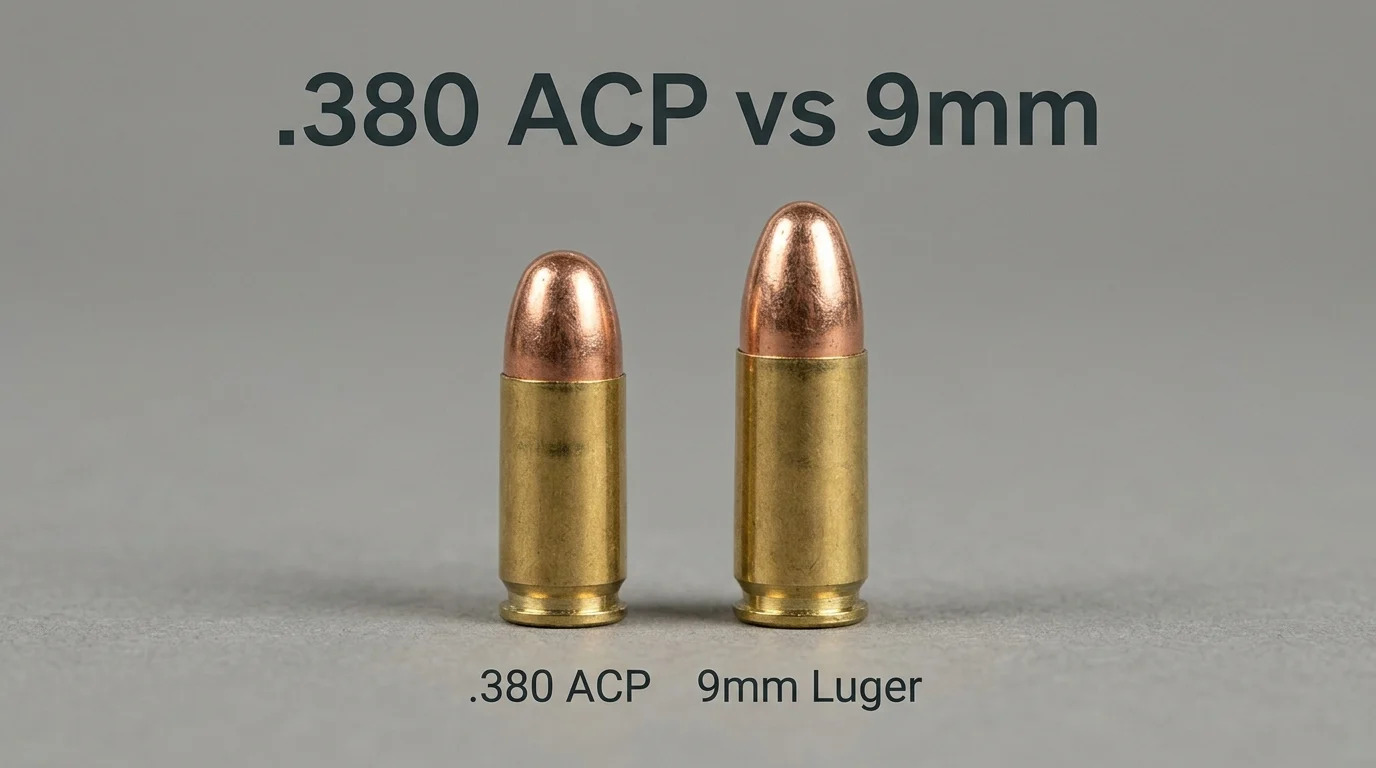
Quick Answer: The main difference between .380 ACP vs 9mm is size and performance. The 9mm cartridge is longer and generally delivers higher muzzle velocity and energy, while the .380 ACP is smaller and typically produces less recoil. Both are common handgun cartridges, but their performance and firearm compatibility differ.
Choosing between .380 ACP and 9mm can be confusing, especially if you are unfamiliar with handgun ammunition. Both cartridges are widely recognized, and their names often appear in discussions about firearm size, recoil, and performance. However, they are not interchangeable.
The .380 ACP, also known as .380 Auto or 9mm Browning Short, has a long history of use in compact handguns. In comparison, 9mm Luger, commonly called 9mm Parabellum, is one of the most widely used handgun cartridges worldwide.
Although both use bullets of approximately 9mm diameter, their case dimensions and typical performance differ. Therefore, understanding these distinctions helps explain why manufacturers design different firearms around each cartridge.
What Is the Difference Between .380 ACP and 9mm?
The biggest differences involve cartridge dimensions, typical muzzle energy, and recoil characteristics. The 9mm Luger generally provides greater velocity and energy, whereas .380 ACP typically offers lower recoil in comparable firearms.
.380 ACP Explained
The .380 ACP was introduced by John Moses Browning in 1908. It uses a relatively short cartridge case and commonly appears in compact pistols.
Because of its smaller cartridge dimensions, manufacturers can design lightweight handguns around it. However, actual firearm size and handling depend on the specific model, not just the ammunition.
9mm Luger Explained
The 9mm Luger was introduced in the early 1900s and became widely adopted by military, law enforcement, and civilian users.
It generally delivers more energy than .380 ACP when comparing typical commercial loads. In addition, the 9mm cartridge works with a broad range of handgun designs, including compact and full-size models.
.380 ACP vs 9mm: Side-by-Side Comparison
| Feature | .380 ACP | 9mm Luger |
|---|---|---|
| Common name | .380 Auto | 9mm Parabellum |
| Bullet diameter | About 9.0 mm | About 9.01 mm |
| Case length | 17.3 mm | 19.15 mm |
| Overall cartridge length | About 25.0 mm | About 29.7 mm |
| Typical performance | Lower velocity and energy | Higher velocity and energy |
| Typical recoil | Often lower | Often higher |
| Common firearms | Compact pistols | Compact and full-size pistols |
Note: Performance varies with bullet weight, ammunition load, barrel length, and firearm design.
Which Has More Power: .380 ACP or 9mm?
Generally, 9mm Luger delivers more muzzle energy than .380 ACP. Its longer case allows manufacturers to develop loads that typically achieve higher velocities.
However, bullet design also matters. Modern ammunition can behave differently depending on its construction and intended purpose. As a result, cartridge names alone do not describe every aspect of performance.
Moreover, muzzle energy is only one measurement. It does not independently determine accuracy, reliability, or overall effectiveness.
Is .380 ACP Easier to Shoot Than 9mm?
The .380 ACP often produces less recoil, particularly when comparing firearms of similar weight and design. Consequently, some shooters find it more comfortable to handle.
Nevertheless, a very small .380 pistol can feel surprisingly sharp because its lightweight frame absorbs less recoil. Similarly, a well-designed 9mm handgun may feel comfortable because of its weight, grip, and recoil-management features.
Therefore, the cartridge alone cannot predict how a firearm will feel. Individual firearm design and the shooter’s experience also matter.
Are .380 ACP and 9mm Interchangeable?
No. Despite their similar bullet diameters, .380 ACP and 9mm Luger are different cartridges and must not be treated as interchangeable.
Their case dimensions, pressure specifications, and firearm chamber requirements differ. Using ammunition that does not match the firearm’s markings can cause serious injury or firearm damage.
Always check the manufacturer’s markings and manual before using ammunition. Never assume a cartridge will fit safely just because its diameter looks similar.
Common Misconceptions
- “Both cartridges have the same diameter, so they are interchangeable.” This is incorrect because their overall dimensions and specifications differ.
- “A larger cartridge always means better performance.” Performance depends on several factors, including ammunition design and firearm characteristics.
- “.380 ACP always has less recoil than 9mm.” It often does, but firearm weight and design can change the experience.
- “9mm is only used in large handguns.” Many compact handguns also use 9mm ammunition.
Frequently Asked Questions
1. Is .380 ACP the same as 9mm?
No. Although both use bullets around 9mm in diameter, .380 ACP and 9mm Luger have different case dimensions and specifications.
2. Is 9mm more powerful than .380 ACP?
Generally, yes. Typical 9mm loads deliver higher muzzle velocity and energy, although exact results vary by ammunition.
3. Does .380 ACP have less recoil?
It often does, but the firearm’s weight, grip, and design influence perceived recoil.
4. Why is .380 ACP also called 9mm Browning Short?
The name distinguishes it from longer 9mm cartridges, including 9mm Luger. Naming conventions can vary across countries and manufacturers.
5. Can a 9mm handgun fire .380 ACP ammunition?
Do not assume it can. Use only ammunition specifically approved for the firearm.
6. Are .380 ACP and 9mm bullets the same diameter?
Their nominal bullet diameters are very close, but that similarity does not make the cartridges interchangeable.
7. Is 9mm more common than .380 ACP?
Yes. The 9mm Luger is widely used across many handgun categories and markets.
8. Which cartridge has a longer case?
The 9mm Luger has a longer case than .380 ACP.
Conclusion
The comparison between .380 ACP and 9mm comes down to cartridge dimensions and typical performance. The .380 ACP is shorter and often produces less recoil, while 9mm Luger generally offers greater velocity and muzzle energy. Most importantly, these cartridges are not interchangeable, so always follow the firearm manufacturer’s ammunition specifications.