
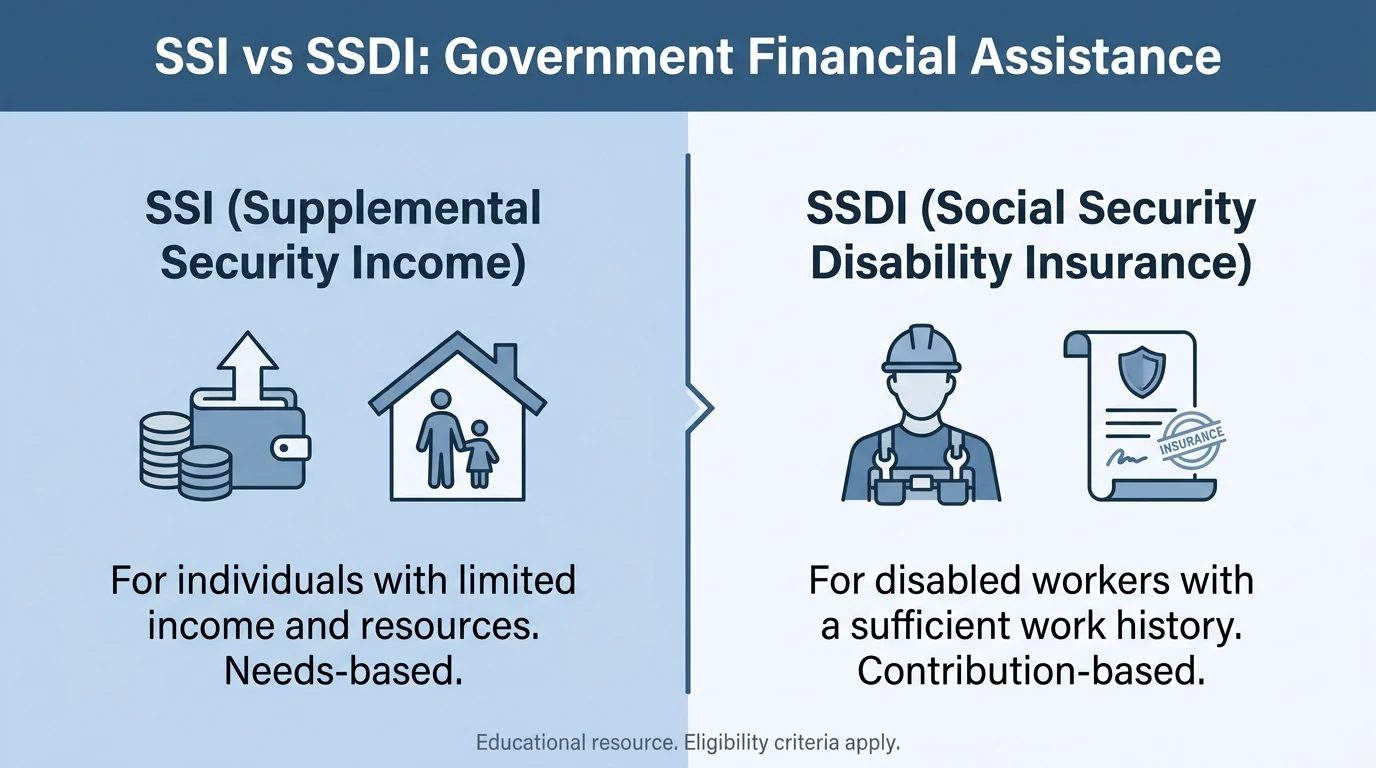
Quick Answer: SSI vs SSDI comes down to how you qualify for benefits. Supplemental Security Income (SSI) helps people with limited income and resources who are aged, blind, or disabled. Social Security Disability Insurance (SSDI) supports people with qualifying disabilities who have enough work credits. Some people qualify for both programs, depending on their circumstances.
Understanding the difference between SSI and SSDI can help you determine which benefits may fit your situation. Both programs provide financial assistance through the Social Security Administration (SSA), but they follow different eligibility rules.
For example, a person who has never worked may qualify for SSI if they meet its disability and financial requirements. However, someone who worked for years and paid Social Security taxes may qualify for SSDI after developing a qualifying disability.
Moreover, these programs differ in how they calculate payments, evaluate income, and provide access to health insurance. Your age, work history, disability status, and financial resources can all affect your eligibility.
In this guide, we’ll explain SSI vs SSDI in simple terms, compare their main features, and show you how to understand which program may be right for you.
What Is SSI?
SSI stands for Supplemental Security Income. It provides monthly payments to eligible people who have limited income and resources.
You may qualify for SSI if you:
- Are age 65 or older.
- Are blind or have a qualifying disability.
- Meet the program’s income and resource limits.
- Meet its citizenship or eligible immigration status and residency requirements.
Unlike SSDI, SSI does not require you to have a work history. Therefore, children with qualifying disabilities and adults who have never worked may also qualify.
For 2026, the maximum federal SSI payment is $994 per month for an eligible individual and $1,491 for an eligible couple. However, your actual payment may be lower depending on your countable income, living arrangements, and other factors. Some states also provide additional payments.
What Is SSDI?
SSDI stands for Social Security Disability Insurance. This program provides monthly benefits to people whose qualifying disabilities prevent them from engaging in substantial work and who meet Social Security’s work history requirements.
To qualify, you generally must:
- Have a medical condition that meets Social Security’s disability rules.
- Be unable to perform substantial gainful activity because of your condition.
- Have enough work credits based on your employment and Social Security tax contributions.
The number of work credits you need depends on your age when your disability begins. Younger workers may qualify with fewer credits.
Unlike SSI, SSDI does not have the same general income and resource limits. However, work earnings can affect eligibility and benefits under specific rules.
Your monthly SSDI payment depends mainly on your covered earnings history. Consequently, people with different work histories may receive different payment amounts.
SSI vs SSDI: Key Differences
| Feature | SSI | SSDI |
|---|---|---|
| Full name | Supplemental Security Income | Social Security Disability Insurance |
| Main requirement | Limited income and resources, plus age, blindness, or disability criteria | Qualifying disability and sufficient work credits |
| Work history | Not required | Usually required |
| Financial limits | Yes | No general asset limit |
| Payment amount | Based on federal rates and individual circumstances | Based mainly on earnings history |
| Health coverage | Medicaid in many cases | Medicare generally after 24 months of SSDI entitlement |
| Eligible applicants | Qualifying older adults, blind people, disabled adults, and children | Qualifying disabled workers and certain eligible family members |
Although both programs provide financial support, they serve different needs. Therefore, you should evaluate your work history and financial situation before deciding which program to pursue.
Can You Receive SSI and SSDI at the Same Time?
Yes. Some people qualify for both SSI and SSDI. The Social Security Administration calls this concurrent benefits.
For example, someone may qualify for SSDI based on previous employment but receive a relatively small monthly payment. If that person also meets SSI’s income and resource requirements, they may qualify for additional SSI assistance.
However, Social Security generally counts SSDI payments as unearned income when calculating SSI eligibility. As a result, receiving SSDI can reduce your SSI payment or make you ineligible for SSI.
You must meet each program’s requirements separately, and qualifying for one does not automatically guarantee approval for the other.
Which Is Better: SSI or SSDI?
Neither program is automatically better. The right option depends on your circumstances.
SSI may be suitable if:
- You have limited income and resources.
- You have a qualifying disability but lack sufficient work credits.
- You are 65 or older and meet the financial requirements.
SSDI may be suitable if:
- You have a qualifying disability.
- You have enough qualifying work credits.
- Your employment history makes you eligible for disability insurance benefits.
In some cases, you may qualify for both. Therefore, consider applying for every program for which you may be eligible.
Common Mistakes to Avoid
- Assuming both programs have identical rules: SSI has financial limits, while SSDI generally depends on disability status and work credits.
- Thinking you must have worked to receive SSI: SSI does not require previous employment.
- Assuming SSDI has no work-related restrictions: Earnings can affect disability eligibility and continuing benefits.
- Believing one application automatically covers everything: You may need to complete separate applications or provide additional information for each program.
Frequently Asked Questions
1. Is SSI the same as SSDI?
No. SSI provides needs-based assistance, while SSDI provides disability insurance benefits based mainly on a qualifying work history.
2. Which pays more, SSI or SSDI?
It depends. SSI has a maximum federal payment, while SSDI payments vary according to your earnings record. Some people receive more through SSDI, but payment amounts differ.
3. Can I receive SSI without working?
Yes. SSI does not require a work history, although you must meet its other eligibility requirements.
4. Can I receive SSDI without enough work credits?
Generally, no. However, certain people may qualify for benefits based on a parent’s or spouse’s Social Security record under specific rules.
5. Does SSI provide health insurance?
SSI recipients often qualify for Medicaid, although the application process and eligibility rules vary by state.
6. Does SSDI include Medicare?
Generally, Medicare coverage begins after 24 months of SSDI entitlement. Special rules may apply to certain medical conditions.
7. Can I work while receiving SSI or SSDI?
Possibly. Both programs have work incentive rules, but earnings can affect eligibility or payment amounts. Report your work activity and earnings to Social Security.
8. How do I apply for SSI or SSDI?
You can start by visiting the Social Security Administration’s official website or contacting a Social Security office. Be prepared to provide information about your medical condition, work history, income, resources, and other relevant details.
Conclusion
The main difference in SSI vs SSDI is how you qualify. SSI focuses on financial need and age, blindness, or disability, whereas SSDI generally requires a qualifying disability and sufficient work credits.
If you have limited income and resources, SSI may be an option. If you have a qualifying work history, SSDI may be appropriate. Since some people qualify for both programs, review the eligibility requirements carefully before applying.
3 thoughts on “SSI vs SSDI: What’s the Difference? Eligibility, Benefits & How to Qualify”