
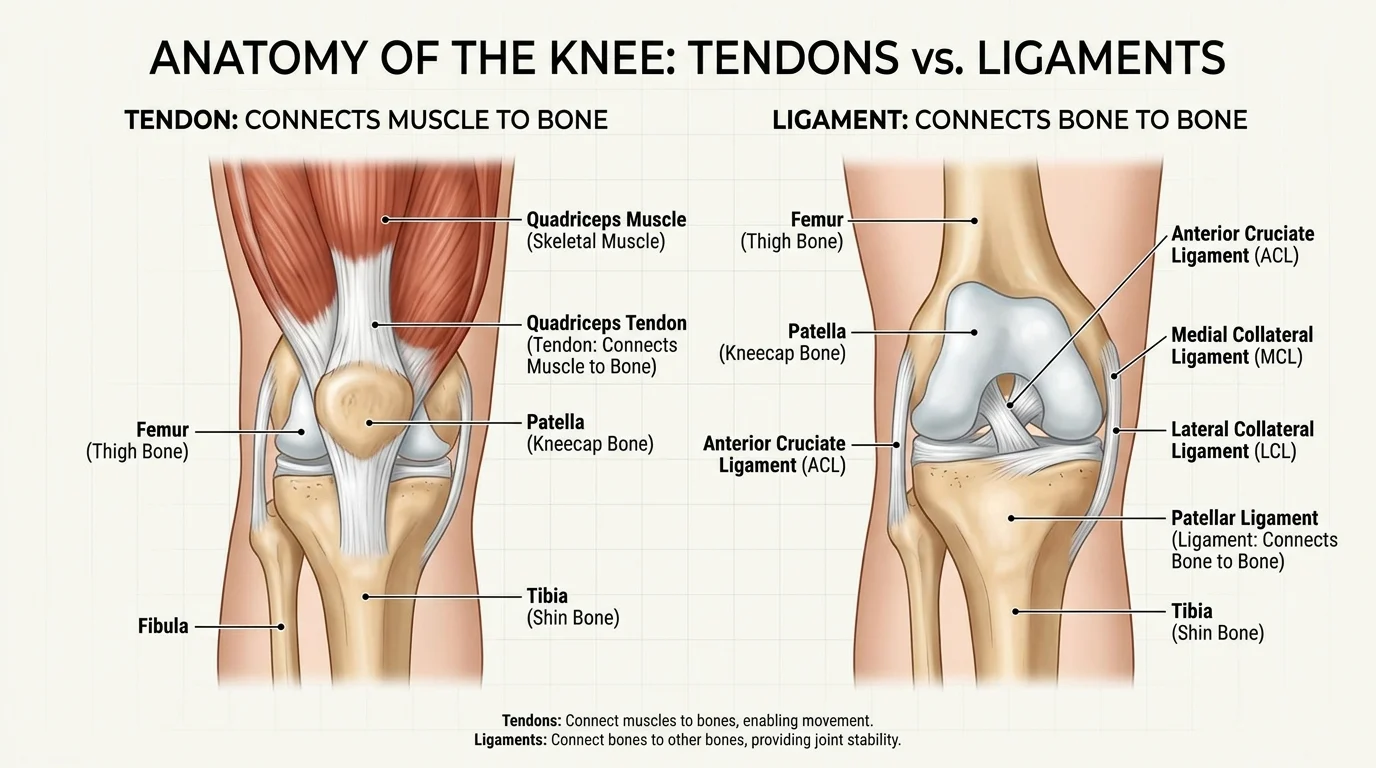
Quick Answer: Tendons and ligaments are strong connective tissues that support movement and stability. Tendons connect muscles to bones, helping your body move, while ligaments connect bones to other bones, helping stabilize joints. Both can stretch or tear during an injury, but tendon injuries often affect movement and muscle function, while ligament injuries may cause joint pain and instability.
Your body depends on muscles, bones, tendons, and ligaments to move smoothly and stay stable. These structures work together when you walk, run, lift objects, exercise, or perform everyday activities. Although tendons and ligaments have similar names and are made largely of strong connective tissue, they serve different purposes.
Understanding tendons vs ligaments is especially useful if you play sports, exercise regularly, or have experienced joint pain. A tendon helps transfer the force produced by a muscle to a bone, allowing movement. A ligament connects bones and helps keep joints stable by limiting excessive movement.
Both structures can become injured through sudden trauma, repetitive activity, or excessive stress. However, the type of injury and its effects can differ. This guide explains their functions, locations, common injuries, and recovery considerations so you can understand how these important tissues help your body work.
Tendons vs Ligaments: Quick Answer
The simplest way to remember the difference is to look at what each structure connects.
- Tendons connect muscle to bone. They transfer muscle force to bones and help produce movement.
- Ligaments connect bone to bone. They support joints and help prevent excessive or abnormal movement.
For example, the Achilles tendon connects the calf muscles to the heel bone. The anterior cruciate ligament, commonly called the ACL, helps stabilize the knee joint.
Both structures are essential for normal movement, but their main jobs are different.
What Are Tendons?
Tendons are tough, fibrous bands of connective tissue that attach muscles to bones. They transmit the force created when muscles contract, allowing bones and joints to move.
Tendons also help control movement and absorb some of the forces placed on the body during activities such as jumping and running.
Main Functions of Tendons
- Transfer force from muscles to bones.
- Help produce controlled body movements.
- Support posture and joint function.
- Store and release some elastic energy during movement.
Examples of Tendons
Achilles tendon: Connects the calf muscles to the heel bone and helps you walk, run, and jump.
Biceps tendon: Connects the biceps muscle to bones in the shoulder and forearm, helping with elbow movement.
Patellar tendon: Connects the kneecap to the shinbone and helps transmit force from the thigh muscles during knee extension.
What Are Ligaments?
Ligaments are strong bands of connective tissue that connect bones to other bones. They help hold joints together and control the range of movement possible at those joints.
Without ligaments, many joints would have less stability and could move beyond their normal limits more easily.
Main Functions of Ligaments
- Connect bones at joints.
- Support joint stability.
- Limit excessive or abnormal movement.
- Help guide normal joint motion.
Examples of Ligaments
Anterior cruciate ligament (ACL): Helps stabilize the knee and control certain movements between the thighbone and shinbone.
Medial collateral ligament (MCL): Supports the inner side of the knee and helps resist excessive sideways movement.
Wrist ligaments: Connect the small bones of the wrist and help maintain their alignment during movement.
Tendons vs Ligaments: Key Differences
| Feature | Tendons | Ligaments |
|---|---|---|
| Main connection | Muscle to bone | Bone to bone |
| Primary function | Transfer muscle force | Stabilize joints |
| Role in movement | Help produce movement | Guide and limit movement |
| Common injury | Tendinopathy or tendon tear | Sprain or ligament tear |
| Possible symptoms | Pain during movement or muscle use | Joint pain, swelling, or instability |
| Example | Achilles tendon | ACL |
Both tissues contain abundant collagen fibers, which give them strength. However, their structure and arrangement reflect their different roles in the body.
Tendon Injuries vs Ligament Injuries
Tendons and ligaments can both be injured by sudden force, overuse, or repetitive stress. However, doctors often describe their injuries differently.
Common Tendon Injuries
Tendinopathy: A broad term for tendon problems involving pain and impaired function, often associated with repetitive loading.
Tendinitis: Inflammation of a tendon. The term is often used for tendon pain, although not every tendon problem is primarily inflammatory.
Tendon tear: A partial or complete disruption of tendon fibers. Severe tears can interfere with normal movement.
Tendon problems commonly affect areas such as the shoulder, elbow, wrist, knee, and heel.
Common Ligament Injuries
Sprain: An injury caused by stretching or tearing a ligament. Sprains can range from mild fiber damage to complete tears.
Ligament tear: A partial or complete disruption that may reduce joint stability.
Ligament injuries often occur when a joint twists, bends, or receives a force beyond its normal range. Ankle sprains and ACL injuries are common examples.
How Can You Tell Which One Is Injured?
Symptoms alone cannot reliably identify whether a tendon or ligament is damaged. Both injuries may cause pain, swelling, tenderness, and difficulty moving the affected area.
Tendon problems may cause pain that increases when the attached muscle contracts or performs a particular movement. Ligament injuries may cause pain around a joint, especially after twisting or sudden changes in direction. Some ligament injuries also produce a feeling that the joint is unstable.
A healthcare professional may examine the affected area and recommend imaging, such as an X-ray or MRI, when appropriate.
Seek medical attention for severe pain, significant swelling, inability to bear weight, obvious deformity, or a sudden injury accompanied by a popping sensation and loss of function.
How Are Tendon and Ligament Injuries Treated?
Treatment depends on the location and severity of the injury. Some mild injuries improve with activity modification, protection, and guided rehabilitation. Others require more specialized care.
Healthcare professionals may recommend physical therapy to restore strength, flexibility, movement, and stability. Severe tendon or ligament tears sometimes require surgery.
Recovery time varies. Both tissues can heal slowly, and returning to strenuous activity too early may worsen an injury. Follow a clinician’s advice before resuming sports or heavy exercise.
Frequently Asked Questions
Are tendons and ligaments the same?
No. Tendons connect muscles to bones, while ligaments connect bones to other bones. Both support normal movement and stability.
Which is stronger, a tendon or a ligament?
There is no simple answer because strength depends on the specific tissue, its size, structure, and the forces applied. Both are strong connective tissues designed for different functions.
Do tendons or ligaments heal faster?
Healing time depends on the injury’s severity, location, blood supply, and treatment. Neither type of injury has a universal recovery time.
Is a sprain a tendon or ligament injury?
A sprain is a ligament injury. A strain usually affects a muscle or tendon.
Can you walk with a torn ligament?
Some people can walk with a ligament tear, while others cannot bear weight comfortably. The ability to walk does not rule out a serious injury.
Can tendons and ligaments both tear?
Yes. Tendons and ligaments can sustain partial or complete tears following trauma or excessive stress.
Do tendons and ligaments contain collagen?
Yes. Both contain collagen fibers that provide strength and help them withstand tension.
When should you see a doctor for a possible injury?
Seek medical assessment if pain is severe, swelling is significant, movement is limited, a joint feels unstable, or you cannot bear weight normally.
Conclusion
Understanding tendons vs ligaments becomes easier when you remember their main connections. Tendons attach muscles to bones and transmit the force needed for movement. Ligaments connect bones to bones and help keep joints stable.
Although both structures contain strong connective tissue, they perform different jobs. Tendon injuries may interfere with muscle function and movement, while ligament injuries may affect joint stability. Both can cause pain, swelling, and reduced mobility.
If you suspect an injury, do not rely on symptoms alone to identify the damaged tissue. A healthcare professional can assess the problem and recommend suitable treatment. With appropriate care and a gradual return to activity, many tendon and ligament injuries can improve over time.