
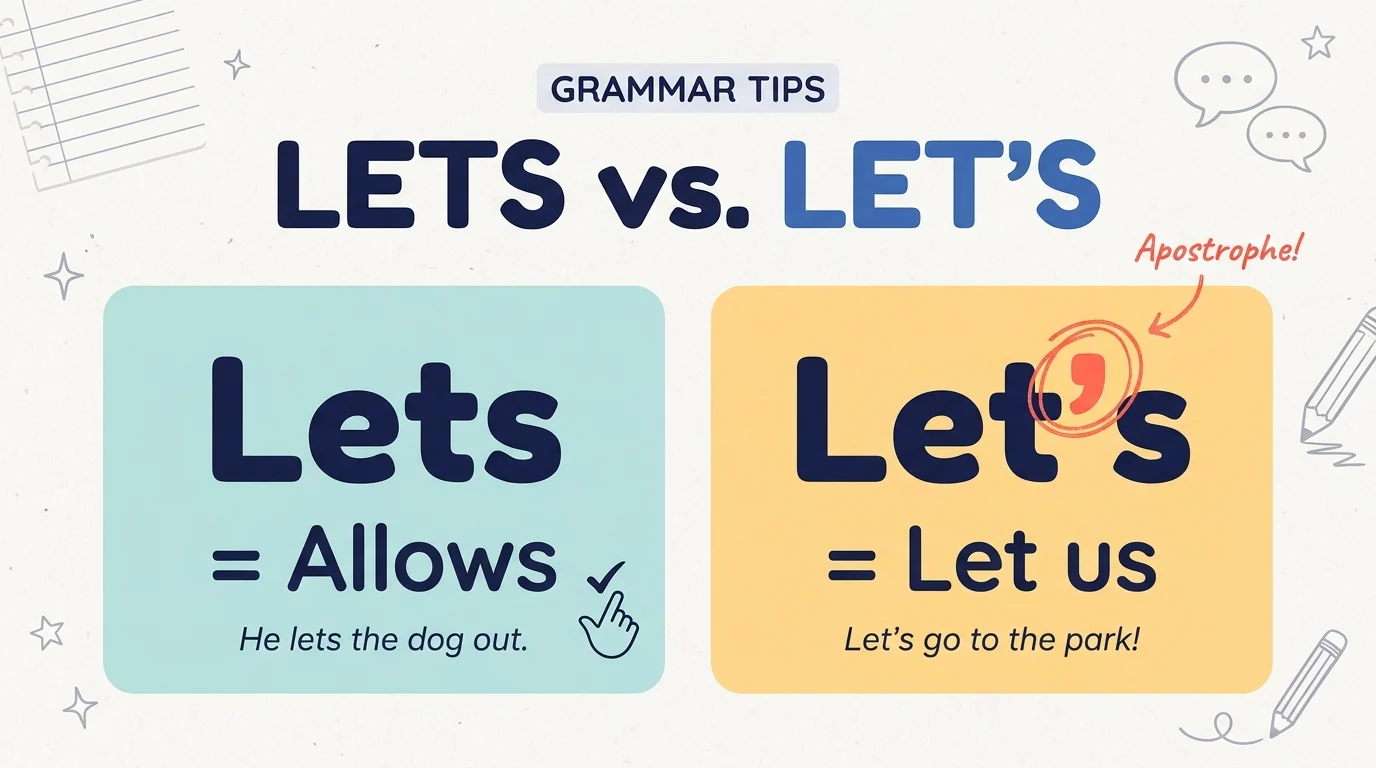
Quick Answer: Lets vs let’s: Let’s is a contraction of “let us” and is used to make suggestions or invite someone to do something. Lets is the third person singular form of the verb “let,” meaning to allow or permit. For example, “Let’s go outside” makes a suggestion, while “She lets her children play outside” means she allows them to play.
Have you ever wondered whether to write lets or let’s? These two forms look almost identical, but the apostrophe changes their meaning and grammatical function. Using the wrong one can make an otherwise clear sentence confusing or grammatically incorrect.
The difference between lets vs let’s becomes easier to understand when you remember one simple rule. Let’s means “let us,” while lets means “allows” or “permits.” The first form is commonly used when suggesting an activity, making a plan, or inviting someone to join you. The second describes what someone allows another person to do.
For example, you might write, “Let’s watch a movie tonight” when suggesting an activity. However, “My brother lets me borrow his car” means your brother allows you to use it.
In this guide, you’ll learn the meanings of both forms, see practical examples, understand common mistakes, and discover a simple trick to choose the correct spelling every time.
Lets vs Let’s: Quick Answer
The difference is the apostrophe and the meaning.
- Let’s: A contraction of “let us,” used to make suggestions or propose an action.
- Lets: The present tense form of “let” used with he, she, or it, meaning allows or permits.
Examples:
- Let’s eat dinner together.
- My mother lets me cook dinner.
Remember, if you can replace the word with “let us,” you need let’s. If you mean “allows,” use lets.
What Does Let’s Mean?
Let’s is a contraction of “let us.” A contraction combines two words into a shorter form, using an apostrophe to show that letters have been omitted.
People commonly use let’s when suggesting an activity, inviting others to participate, or encouraging a group to do something.
Examples of let’s in sentences:
- Let’s go for a walk.
- Let’s finish our homework before dinner.
- Let’s celebrate your birthday this weekend.
- Let’s try a different restaurant.
- Let’s see what happens next.
In each sentence, the speaker proposes an action. The word usually creates a friendly, cooperative tone.
You can also use let’s in questions and expressions.
- Let’s get started, shall we?
- Let’s not argue about this.
- Let’s remember to bring our tickets.
In everyday English, let’s is common in conversations, messages, emails, and informal writing. It can also appear in professional writing when the tone is collaborative.
What Does Lets Mean?
Lets is the third person singular present tense form of the verb “let.” It means to allow, permit, or give someone the opportunity to do something.
Use lets when the subject is he, she, it, or a singular noun.
Examples of lets in sentences:
- She lets her children watch television after homework.
- My teacher lets us use dictionaries during the activity.
- He lets his dog sleep on the sofa.
- The manager lets employees leave early on Fridays.
- This app lets users edit photos easily.
Notice that lets describes an action or permission. It does not suggest that the speaker and another person should do something together.
For example, “She lets me drive her car” means she allows me to drive it. It does not mean “She suggests that we drive her car.”
Lets vs Let’s: Key Differences
| Feature | Lets | Let’s |
|---|---|---|
| Grammar | Verb | Contraction |
| Full form | No contraction | Let us |
| Main meaning | Allows or permits | Suggests an action |
| Typical subject or use | He, she, it, or a singular noun | Often used to suggest something |
| Example | He lets me help. | Let’s help him. |
The easiest way to remember the distinction is to focus on the meaning rather than the appearance of the word.
Common Mistakes to Avoid
1. Using lets when making a suggestion
Incorrect: Lets go shopping.
Correct: Let’s go shopping.
The sentence suggests an activity, so the contraction of “let us” is required.
2. Adding an apostrophe when describing permission
Incorrect: My dad let’s me use his laptop.
Correct: My dad lets me use his laptop.
Here, lets means “allows,” so no apostrophe is needed.
3. Assuming the apostrophe always indicates possession
An apostrophe can indicate possession in some words, but that’s not what happens in let’s. In this case, the apostrophe marks a contraction.
4. Forgetting the subject in a sentence
Incorrect: They lets us play outside.
Correct: They let us play outside.
With subjects such as they, we, and I, use the base form let, not lets.
How to Remember Lets vs Let’s
Use this simple replacement trick whenever you are unsure.
Step 1: Read your sentence aloud.
Step 2: Replace the word with “let us.”
Step 3: Check whether the sentence still makes sense.
For example:
“Let’s take a break” becomes “Let us take a break.” The sentence works, so let’s is correct.
“She lets me take a break” becomes “She allows me take a break.” The intended meaning is permission, so lets is correct. For a more natural replacement, say “She allows me to take a break.”
Practice: Choose the Correct Word
Fill in each blank with lets or let’s.
- _____ go to the park this afternoon.
- My sister _____ me borrow her books.
- _____ make a list before we start.
- The teacher _____ students ask questions.
- _____ not waste any more time.
Answers:
- Let’s
- Lets
- Let’s
- Lets
- Let’s
Remember the rule: suggestions use let’s, while permission uses lets.
Frequently Asked Questions
Is lets or let’s correct?
Both are correct, but they have different meanings. Let’s means “let us,” while lets means “allows” or “permits.”
Why does let’s have an apostrophe?
The apostrophe shows that letters have been omitted from “let us” to form the contraction let’s.
Is let’s short for let us?
Yes. Let’s is the standard contraction of “let us.”
What is an example of lets without an apostrophe?
“My father lets me stay up late on weekends.” Here, lets means allows.
Can I use let’s in formal writing?
Yes. Let’s can be appropriate in professional or formal writing when making suggestions, although a more formal alternative may sometimes suit the context better.
Is lets a verb?
Yes. Lets is the third person singular present tense form of the verb let.
What is the easiest way to remember lets vs let’s?
Replace let’s with “let us.” If the sentence makes sense, use the apostrophe. If you mean “allows,” use lets.
Conclusion
Understanding lets vs let’s is simple once you know what each word means. Let’s is a contraction of “let us” and is used to suggest an activity, invite participation, or encourage action. Lets, without an apostrophe, is the verb form meaning “allows” or “permits.”
For example, “Let’s play a game” suggests an activity, while “She lets us play a game” describes permission. The apostrophe is small, but it changes how the word functions in a sentence.
Whenever you feel unsure, try replacing let’s with “let us.” If the sentence still makes sense, the apostrophe belongs there. Otherwise, check whether you mean “allows” or “permits.”
With this simple rule and a little practice, you’ll be able to use lets and let’s confidently in everyday conversations, emails, and professional writing.