
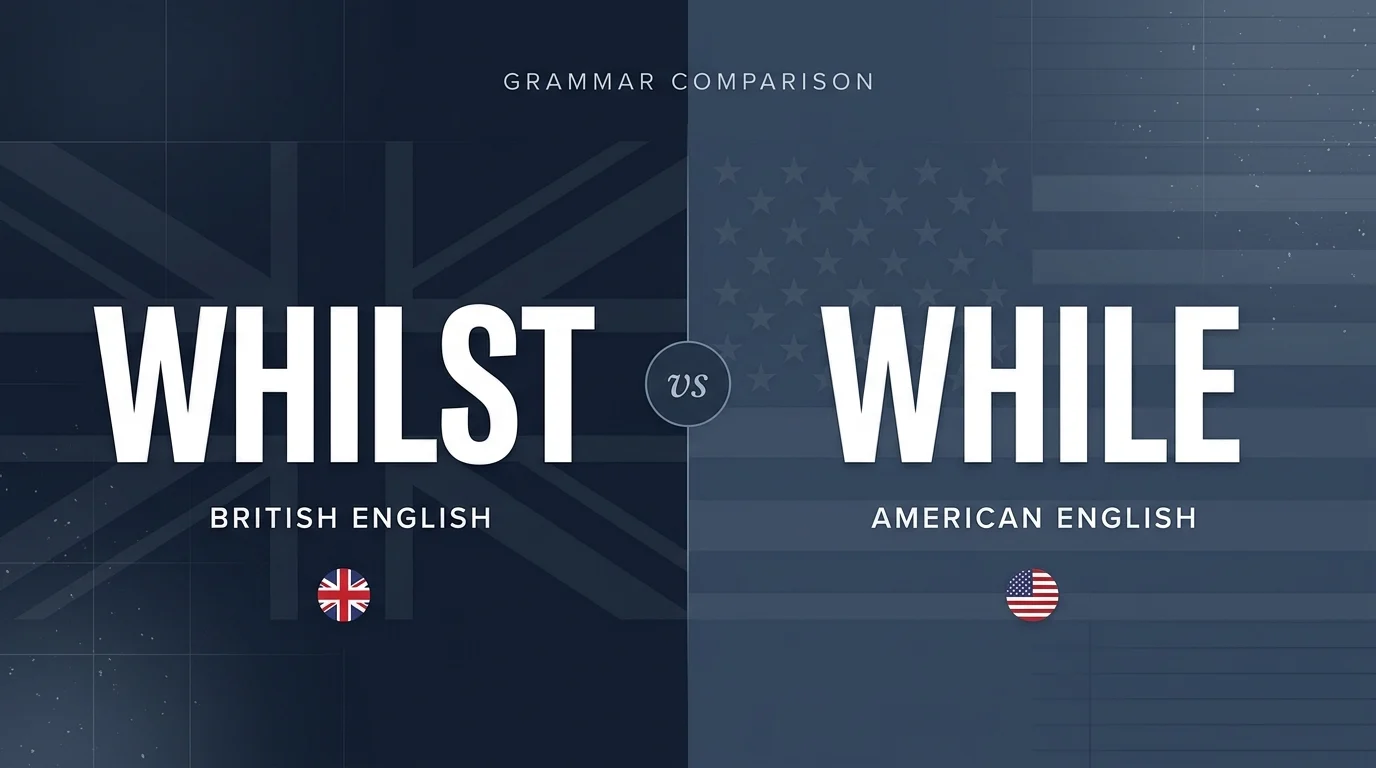
Quick Answer: Whilst and while have the same basic meaning and are often interchangeable. Both can refer to something happening at the same time or introduce a contrast. However, while is more common in American English, whereas whilst is used more often in British English and can sound more formal. In most everyday writing, while is the simpler choice.
Have you ever wondered whether to write whilst or while? Both words appear in books, articles, conversations, and formal writing. Since they share the same basic meaning, choosing between them can feel confusing.
The good news is that you do not need to learn two completely different sets of grammar rules. In most situations, whilst and while can be used in the same way. The main difference involves regional preference, writing style, and tone.
While is the more common choice in modern American English. In contrast, whilst appears more frequently in British English and may sound slightly more formal or traditional. Both words can describe two actions happening at the same time or introduce a contrasting idea.
In this guide, you will learn the difference between whilst and while, see practical examples, and discover when each word works best. By the end, you will be able to choose the right word confidently in everyday conversations, school assignments, emails, and professional writing.
Whilst vs While: Quick Answer
Whilst and while are both correct English words. They can function as conjunctions and, in certain constructions, nouns or prepositions.
- While: The more common and versatile option, especially in American English.
- Whilst: More common in British English and sometimes considered more formal.
- Meaning: Both can express simultaneous actions or contrast.
- Best everyday choice: Use while when you are unsure which word to choose.
For example, “I listened to music while studying” and “I listened to music whilst studying” are both grammatically correct.
What Does While Mean?
While is a conjunction that commonly describes two actions happening at the same time. It can also introduce contrast between two statements.
Examples of While
- I cooked dinner while my brother cleaned the kitchen.
- She listened to a podcast while walking home.
- While I enjoy coffee, my sister prefers tea.
- He read a book while waiting for the bus.
- While the hotel was expensive, the service was excellent.
In the first four examples, while connects actions or ideas related to time. In the final example, it introduces a contrast between the hotel’s price and its service.
While can also function as a noun in expressions such as “Stay for a while.” In this sentence, it refers to a period of time.
What Does Whilst Mean?
Whilst has the same basic meaning as while in many contexts. It can introduce simultaneous actions or contrast between ideas.
However, whilst is more strongly associated with British English. Depending on the context, it may sound formal, literary, or slightly old-fashioned. It is still a valid word and is not grammatically incorrect.
Examples of Whilst
- I cooked dinner whilst my brother cleaned the kitchen.
- She listened to a podcast whilst walking home.
- Whilst I enjoy coffee, my sister prefers tea.
- He read a book whilst waiting for the bus.
- Whilst the hotel was expensive, the service was excellent.
These sentences communicate essentially the same meanings as their versions with while. The difference is mainly stylistic and regional rather than grammatical.
Whilst vs While: Key Differences
| Feature | While | Whilst |
|---|---|---|
| Basic meaning | During the time that; although | During the time that; although |
| Grammar | Conjunction and noun in common uses | Primarily a conjunction in these uses |
| American English | Very common | Less common |
| British English | Very common | More common than in American usage |
| Tone | Neutral and versatile | Can sound more formal or traditional |
| Everyday writing | Recommended | Correct, but less common in some contexts |
Both words are correct. Your choice usually depends on the audience, region, and tone you want to achieve.
When Should You Use While or Whilst?
1. Use While for Everyday Writing
While is a safe choice for emails, schoolwork, blog posts, reports, and casual conversations. It sounds natural to a wide English speaking audience.
Example: “Please call me while you are on your way.”
2. Use Whilst for a More Traditional British Style
Whilst can suit British English writing when it matches the author’s usual style. However, you do not need to use it simply because a document is formal.
Example: “Whilst the proposal has merit, further research is required.”
The sentence is correct with while as well.
3. Use While for American Audiences
American readers are generally more familiar with while in everyday communication. If you are writing for a US audience, while is usually the better option.
Example: “While the results look promising, more testing is needed.”
4. Keep Your Writing Consistent
If you choose whilst for a particular style, use it consistently where appropriate. Avoid switching between whilst and while without a reason. Still, remember that while may be more natural in many sentences and does not need replacing.
Common Mistakes to Avoid
| Incorrect assumption | What you should know |
|---|---|
| Whilst is grammatically wrong. | Whilst is a correct English word. |
| While is only used in American English. | While is common in both American and British English. |
| Whilst always sounds more intelligent. | It can sound formal or traditional, but it is not automatically better. |
| The two words always express time. | Both can also introduce contrast. |
| You must use whilst in formal British writing. | While is also appropriate in formal writing. |
Easy rule to remember: When in doubt, use while. It is widely accepted, natural, and suitable for almost every context.
Practice Exercise: Whilst or While?
Choose the word that best fits each sentence. In most cases, both answers are grammatically possible.
- I read the news _____ eating breakfast.
- _____ the plan was expensive, it was effective.
- She called me _____ she was travelling.
- _____ I understand your concern, I disagree with your conclusion.
- He listened carefully _____ the teacher explained the lesson.
Answers
- While or whilst
- While or whilst
- While or whilst
- While or whilst
- While or whilst
For everyday American English, while is generally the more natural choice. In British English, either word may work, depending on the writer’s style.
Frequently Asked Questions
Is whilst correct English?
Yes. Whilst is a correct English word that can mean during the time that or although. It is more common in British English than in American English.
Is whilst more formal than while?
Whilst can sound more formal, literary, or traditional. However, the difference is not absolute. While is also appropriate for professional and academic writing.
Do whilst and while mean the same thing?
They share the same basic meanings in many sentences. Both can describe simultaneous actions and introduce contrast.
Which word should I use in American English?
Choose while for most American English writing and conversation. It is the more common and widely accepted option.
Which word is more common in British English?
Both words are used in British English. Whilst is more common there than in American English, although while remains widely used.
Can I use whilst in an academic essay?
Yes. Whilst is grammatically acceptable in academic writing. However, while is often the simpler choice, so follow your institution’s style guidance and maintain consistency.
Is whilst old-fashioned?
Whilst can sound traditional or literary in some contexts, but it is still used in modern British English. Whether it sounds old-fashioned depends on the audience and sentence.
Can while mean although?
Yes. For example, “While the task was difficult, we completed it on time.” Here, while introduces a contrast rather than describing simultaneous actions.
Conclusion
The difference between whilst and while is mainly about regional usage and style. Both words are correct, and both can describe actions happening at the same time or introduce a contrasting idea.
While is the more common choice in American English and works naturally in everyday, academic, and professional writing. Whilst is more common in British English and can create a slightly formal or traditional tone. Nevertheless, it is not inherently more correct or more sophisticated than while.
If you are unsure which word to use, choose while. It is widely understood and suitable for nearly every situation. When writing for a specific audience, consider regional preferences and follow any relevant style guidelines.
Ultimately, the best word is the one that communicates your meaning clearly and fits your writing naturally. You do not need to overthink this distinction because, in most sentences, either word will work.