
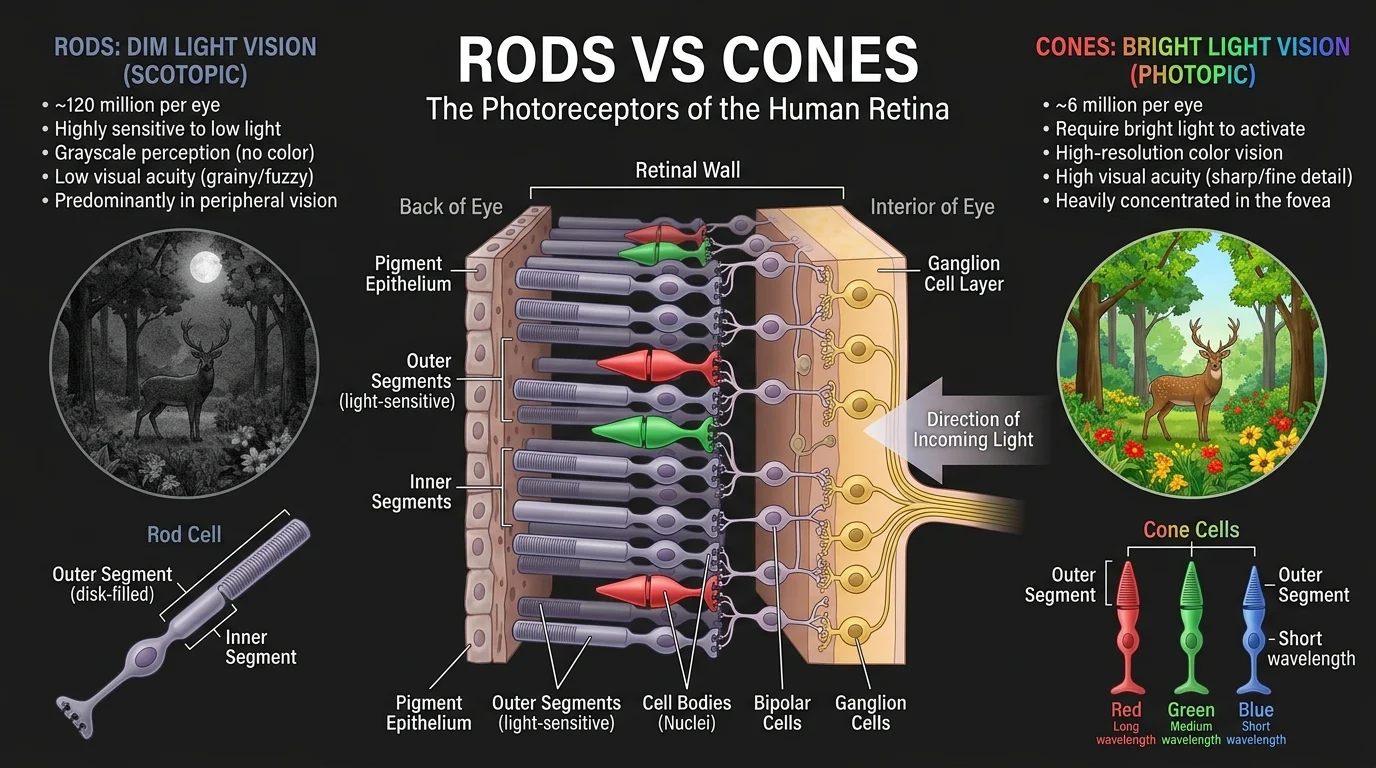
Quick Answer: Rods and cones are specialized photoreceptor cells in the retina that help your eyes detect light. Rods are highly sensitive to dim light and support night vision, while cones work best in brighter conditions and allow you to see colors and fine details. Together, these cells help you see clearly in different lighting conditions.
Have you ever wondered why colors look less vivid at night or why it becomes difficult to recognize small details in a dark room? The answer lies in two specialized cells inside your eyes: rods and cones. These photoreceptor cells are located in the retina, the light sensitive tissue at the back of the eye.
Although rods and cones both respond to light, they perform different functions. Rods help you see when lighting is dim, such as when you walk outside at night. Cones allow you to recognize colors, read text, and see fine details when enough light is available.
Understanding rods vs cones is important for learning how human vision works. These cells convert light into electrical signals that travel through the visual system to the brain, where the signals are processed into the images you see.
In this guide, you will learn the main differences between rods and cones, where they are located, how they work, and why both are essential for everyday vision.
Rods vs Cones: Quick Answer
Rods and cones are the two main types of photoreceptor cells in the human retina.
- Rods: Detect low levels of light and support night vision. They do not provide color vision and have limited ability to distinguish fine details.
- Cones: Function best in brighter light and provide color vision, sharp details, and high visual resolution.
Rods are especially important in dark environments, while cones are essential for reading, recognizing faces, and identifying colors during daylight.
What Are Rods?
Rods are photoreceptor cells that help the eyes detect light in dim conditions. They are extremely sensitive to light, making them useful when illumination is too low for cones to function effectively.
The human retina contains approximately 120 million rods, although the exact number varies between individuals.
Functions of Rods
Rods perform several important functions:
- Support vision in dim light and darkness.
- Help detect movement in low light.
- Assist with peripheral vision.
- Respond to very small amounts of light.
- Help the eyes adjust when moving from a bright environment into darkness.
Rods contain a light sensitive pigment called rhodopsin. When light reaches this pigment, it triggers a series of chemical reactions that help convert the light stimulus into an electrical signal.
However, rods do not distinguish colors. They mainly provide information about light intensity, which is why objects often appear in shades of gray when you look around in very dim conditions.
What Are Cones?
Cones are photoreceptor cells responsible for color vision and detailed sight. They work best in bright or well lit environments, such as outdoors during the day or inside a brightly illuminated room.
The human retina contains approximately 6 million cones. Although there are fewer cones than rods, they are essential for many everyday visual tasks.
Functions of Cones
Cones help you:
- See different colors.
- Read books and screens.
- Recognize faces and objects.
- Distinguish fine details.
- Perform tasks that require sharp vision.
Humans generally have three types of cones, each with different light sensitive pigments. These are often described as short, medium, and long wavelength sensitive cones. Their responses overlap, allowing the brain to interpret a wide range of colors.
Cones are especially concentrated in the fovea, a small central region of the retina responsible for sharp central vision. This concentration helps you focus on details when reading or looking directly at an object.
Rods vs Cones: Key Differences
| Feature | Rods | Cones |
|---|---|---|
| Main function | Dim light vision | Color and detailed vision |
| Light sensitivity | Very high | Lower |
| Best lighting | Dim conditions | Bright conditions |
| Color vision | No | Yes |
| Visual detail | Lower | Higher |
| Approximate number | 120 million | 6 million |
| Main retinal distribution | More common in the peripheral retina | Concentrated in the fovea |
| Light sensitive pigment | Rhodopsin | Cone photopigments |
| Night vision | Essential | Limited in very dim light |
Both cell types are necessary because they allow the visual system to work across a wide range of lighting conditions.
How Do Rods and Cones Work Together?
Rods and cones work together to provide vision throughout the day and night. Their activity changes depending on how much light reaches the retina.
In bright conditions, cones provide most of the information needed for color vision and fine detail. When you enter a dark room, your vision may initially seem poor because your eyes need time to adapt.
During this adjustment, rods gradually become more effective at detecting low levels of light. This process is called dark adaptation. It can take several minutes, and full adaptation may take around 20 to 30 minutes or longer, depending on the conditions.
In very dim light, rods become the primary photoreceptors supporting vision. As a result, colors become difficult to distinguish, and fine details may appear less clear.
This cooperation allows you to move between bright and dark environments without needing separate visual systems.
Why Do Colors Look Different at Night?
Colors look less vivid at night because rods become more important as light levels decrease. Unlike cones, rods do not provide color information.
For example, a red flower may appear bright and colorful during the day. At night, however, it may look dark and difficult to distinguish from surrounding objects.
This does not mean that the flower has changed color. Instead, the reduced light limits the activity of cones, and your visual system relies more heavily on rods.
This is also why driving at night can make it harder to recognize certain colors and see small objects clearly.
What Happens If Rods or Cones Do Not Work Properly?
Problems affecting rods or cones can lead to different types of visual difficulties.
Rod dysfunction may cause difficulty seeing in dim light or adapting to darkness. Some inherited retinal conditions affect rods early, leading to night vision problems and sometimes reduced peripheral vision.
Cone dysfunction may cause reduced color discrimination, difficulty seeing fine details, or sensitivity to bright light. Certain inherited retinal disorders can affect cone function.
Some eye diseases affect both types of photoreceptors. If you notice persistent night blindness, changes in color vision, or worsening vision, consult an eye care professional for an examination.
Frequently Asked Questions
Are rods or cones responsible for color vision?
Cones are responsible for color vision. Rods detect light intensity but do not distinguish colors.
Which cells help you see in the dark?
Rods are the main photoreceptors used for vision in dim light because they are more sensitive to low levels of illumination.
Are there more rods than cones?
Yes. The human retina contains approximately 120 million rods and 6 million cones.
Where are rods and cones located?
Both are located in the retina. Rods are more common in the peripheral retina, while cones are concentrated in the fovea, which supports sharp central vision.
Why do rods not provide color vision?
Rods primarily signal changes in light intensity rather than providing the separate wavelength information needed for color discrimination.
Which cells help you read clearly?
Cones are essential for reading because they provide sharp central vision and allow you to distinguish small details.
Do rods and cones work at the same time?
Yes. Both can respond to light, but their relative contributions depend on the lighting conditions.
What is the main difference between rods and cones?
Rods support vision in dim light, while cones provide color vision and fine detail in brighter conditions.
Conclusion
The main difference between rods and cones is the type of vision they support. Rods are highly sensitive photoreceptors that help you see in dim light, detect movement, and maintain peripheral vision. Cones work best in brighter conditions and allow you to recognize colors, read text, and see fine details.
Although their functions differ, both types of cells are essential for healthy vision. They convert light into electrical signals that travel through the visual system to the brain, allowing you to interpret your surroundings.
Understanding rods vs cones also explains why colors become less noticeable at night and why your eyes need time to adjust when you enter a dark environment. These specialized cells work together to help you see across changing light conditions, from bright sunshine to dimly lit rooms.
3 thoughts on “Rods vs Cones: How Your Eyes See in Light and Darkness”