
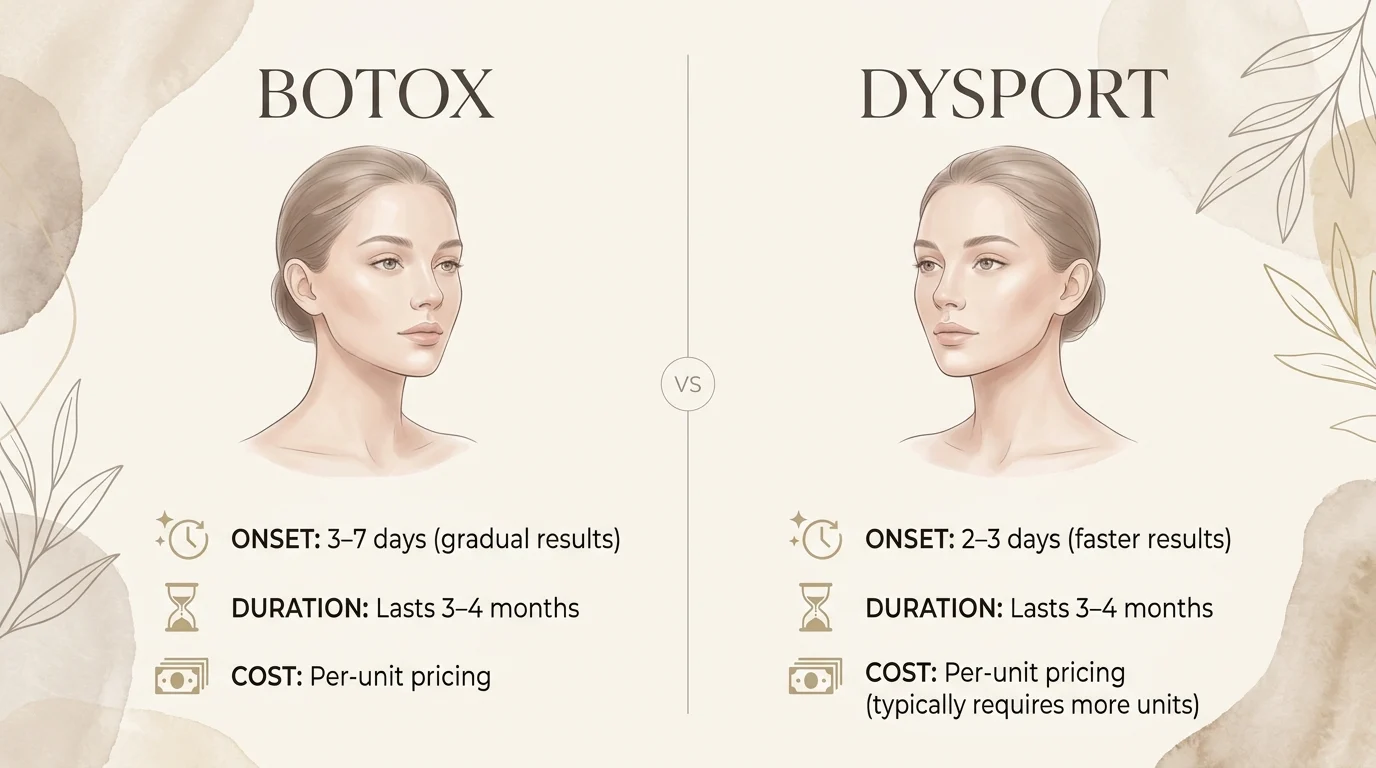
Quick Answer: Botox vs Dysport compares two injectable treatments that temporarily relax facial muscles to soften expression lines and wrinkles. Both contain botulinum toxin type A, but they differ in formulation, dosing, and approved uses. Dysport may begin working sooner for some people, while both treatments typically last around three to four months. The right choice depends on your goals and provider’s assessment.
If you are considering injectable treatments for forehead lines or wrinkles between your eyebrows, you have probably come across Botox and Dysport. Both are popular options for reducing the appearance of expression lines without surgery. Although they work in similar ways, they are not identical products.
The main difference between Botox and Dysport involves their formulations, dosing, and how they may perform for different people. Some patients notice results sooner with Dysport, while others prefer Botox based on their previous experience or treatment goals. However, neither product is automatically better for everyone.
Cost, duration, treatment area, and the experience of the injector also matter when choosing between them. Understanding these factors can help you ask better questions during a consultation and set realistic expectations.
In this guide, we compare Botox vs Dysport, including how they work, how quickly results appear, how long they last, potential side effects, and what to consider before treatment.
Botox vs Dysport: Quick Answer
Botox and Dysport are injectable neuromodulators made from botulinum toxin type A. They temporarily reduce muscle activity, helping soften wrinkles caused by repeated facial expressions.
- Botox: A widely recognized treatment used for several cosmetic and medical indications.
- Dysport: Another botulinum toxin treatment commonly used to soften frown lines.
- Results: Both usually begin showing effects within several days.
- Duration: Cosmetic results commonly last around three to four months, although individual results vary.
- Best choice: Depends on the treatment area, desired outcome, medical history, and injector’s recommendation.
What Is Botox?
Botox Cosmetic is a brand of injectable botulinum toxin type A. It works by temporarily blocking nerve signals that tell targeted muscles to contract. As those muscles relax, expression lines can become less noticeable.
Providers commonly use Botox Cosmetic to improve the appearance of forehead lines, frown lines between the eyebrows, and crow’s feet around the eyes. Other Botox formulations and approved indications are used for certain medical conditions.
The treatment does not permanently remove wrinkles. Instead, it temporarily reduces the muscle movements that contribute to them.
Results develop gradually, so the treated area may not look different immediately after an appointment. A qualified provider can explain the expected timeline and whether Botox suits your goals.
What Is Dysport?
Dysport is an injectable treatment containing abobotulinumtoxinA, another form of botulinum toxin type A. Like Botox, it temporarily reduces activity in targeted muscles.
Dysport is commonly used to improve the appearance of moderate to severe frown lines between the eyebrows. Its suitability for other areas depends on local approvals, clinical judgment, and the treatment being considered.
Some people notice an effect from Dysport sooner than they do with Botox. However, response times vary, and no product guarantees faster or better results for every patient.
A trained medical professional can assess facial anatomy, muscle strength, and treatment goals before recommending Dysport.
Botox vs Dysport: Key Differences
| Feature | Botox | Dysport |
|---|---|---|
| Active ingredient | OnabotulinumtoxinA | AbobotulinumtoxinA |
| Treatment type | Neuromodulator injection | Neuromodulator injection |
| Main cosmetic use | Several approved wrinkle areas | Commonly used for frown lines |
| Onset | Often several days | May begin working sooner for some people |
| Duration | Commonly 3 to 4 months | Commonly 3 to 4 months |
| Dosing units | Product specific | Product specific |
| Cost | Depends on provider and dose | Depends on provider and dose |
These are general comparisons, not guarantees. Results and approved uses vary by product, country, treatment area, and individual.
Which Works Faster: Botox or Dysport?
Dysport may begin showing results sooner for some patients, sometimes within two to three days. Botox often starts showing effects within three to five days. However, these timelines are approximate, and individual responses can differ.
The full effect takes longer to develop with either treatment. Therefore, do not judge your final results immediately after the injection.
If you have an important event coming up, discuss timing with your provider well in advance. Getting injections at the last minute may leave insufficient time to assess the results or manage unwanted effects.
Which Lasts Longer: Botox or Dysport?
Both treatments commonly last around three to four months for cosmetic wrinkle reduction. Some people notice that their results fade sooner, while others maintain improvements for longer.
Duration can depend on the treatment area, dose, muscle activity, individual response, and injector technique. Your results may also differ from those of friends or family members who receive the same product.
Neither Botox nor Dysport is guaranteed to last longer for every person. Your previous treatment history may help your provider recommend an option that suits your needs.
Botox vs Dysport: Cost Comparison
The cost of Botox and Dysport varies according to the clinic, provider experience, treatment area, and amount of product used.
Dysport may have a lower price per unit, but its dosing units are not equivalent to Botox units. As a result, comparing the cost per unit alone can be misleading.
Ask clinics for the estimated total cost of treating your intended area. You should also consider the provider’s qualifications, the product’s authenticity, and the quality of care rather than choosing solely by price.
Because prices vary by location, request a personalized quote before booking.
Side Effects and Safety
Both treatments can cause temporary side effects, including:
- Redness, swelling, or bruising at the injection site
- Mild discomfort or headache
- Temporary eyelid or eyebrow drooping
- Unwanted changes in facial expression
Rarely, botulinum toxin effects can spread beyond the injection area and cause serious symptoms. Seek immediate medical attention if you experience difficulty swallowing, speaking, or breathing after treatment.
For safety, choose a qualified, appropriately licensed healthcare professional who has experience with facial anatomy and injectable treatments. Avoid injections in nonmedical settings or from unqualified providers.
Which Is Better for You?
There is no universal winner in the Botox vs Dysport comparison. Both can reduce expression lines when used appropriately by a qualified professional.
Your provider may consider the area you want to treat, your facial anatomy, previous treatment results, medical history, and personal preferences. They can also explain expected costs, potential risks, and the likely duration of results.
Before making a decision, ask about the provider’s experience, the product being used, and the plan for follow-up if your results are uneven or an unwanted effect occurs.
Frequently Asked Questions
Is Dysport better than Botox?
Not necessarily. Both treatments can work well, and the better option depends on your treatment goals, anatomy, and individual response.
Does Dysport work faster than Botox?
Dysport may begin working sooner for some people, but results vary. Neither product guarantees a faster response.
Do Botox and Dysport last the same amount of time?
Both commonly last around three to four months, although individual results may last for shorter or longer periods.
Can you switch from Botox to Dysport?
A qualified provider can assess whether switching is appropriate. Tell them which product you previously received, when you received it, and how you responded.
Are Botox and Dysport units interchangeable?
No. Their dosing units are product specific and should not be converted directly. A qualified provider must determine the appropriate dose for each product.
Do Botox and Dysport make your face look frozen?
Not necessarily. Treatment aims to reduce targeted muscle activity. The result depends on the dose, injection technique, facial anatomy, and treatment goals.
Which is cheaper, Botox or Dysport?
Neither is always cheaper. Compare the total price for your treatment area rather than the price per unit alone.
Is Botox or Dysport safer?
Both can cause side effects and serious complications, although severe problems are uncommon when treatment is appropriately administered. Provider qualifications and correct product use are important safety factors.
Conclusion
The main difference in Botox vs Dysport comes down to their specific formulations, dosing, and how each person responds. Both are botulinum toxin type A treatments that temporarily relax targeted muscles and soften expression lines. Dysport may begin working sooner for some people, but both commonly provide results for around three to four months.
Cost, treatment area, medical history, and provider experience should all influence your decision. Since the products use different dosing systems, their units cannot be directly exchanged or compared.
Before choosing a treatment, consult a qualified healthcare professional who can explain the benefits, risks, expected costs, and realistic outcomes for your needs. A carefully planned treatment is more important than choosing a product based on popularity alone.
2 thoughts on “Botox vs Dysport: Differences, Results, Cost & Duration”