
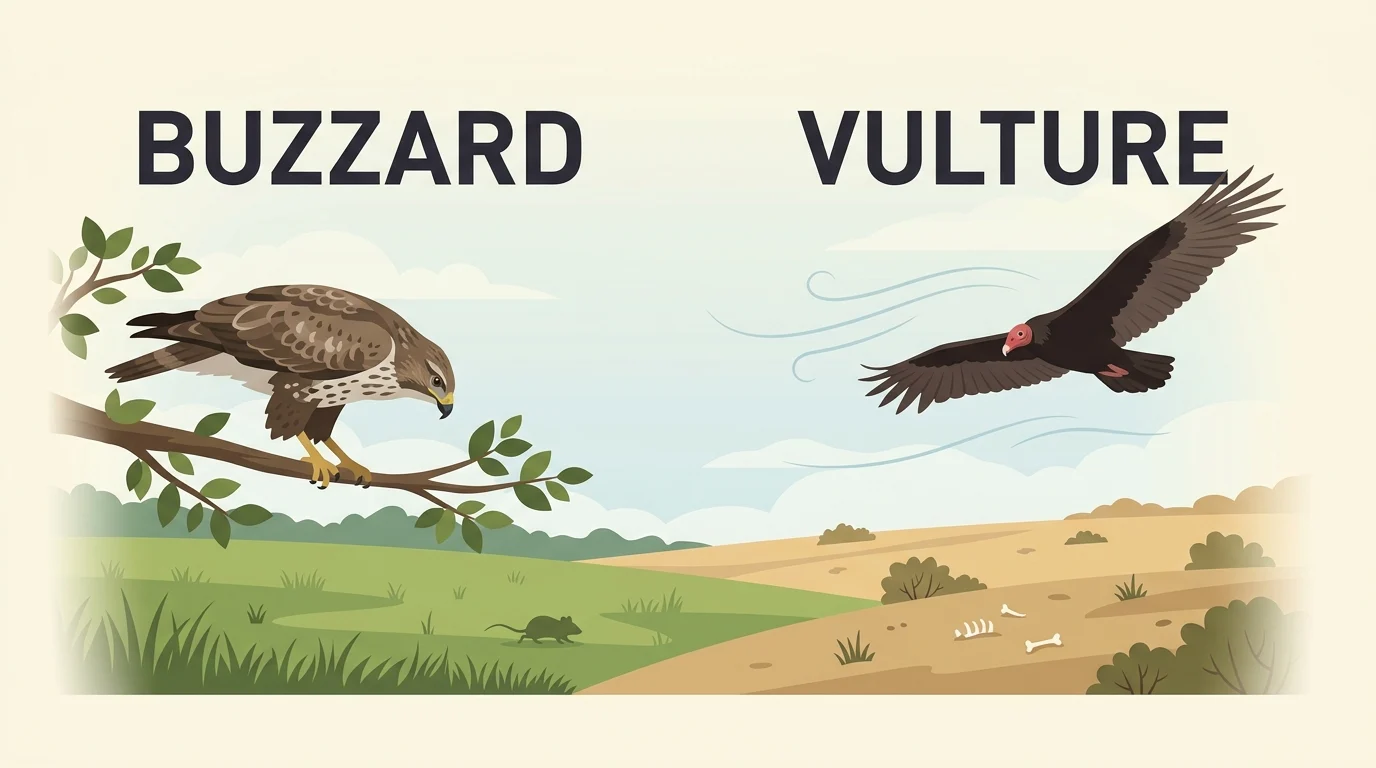
Quick Answer: buzzard vs vulture is a common source of confusion because the meanings vary by region. In British English, a buzzard is usually a hawk like bird that hunts small animals, while a vulture mainly feeds on dead animals. In American English, buzzard often refers to a vulture, including the turkey vulture.
Have you ever wondered whether a buzzard and a vulture are the same bird? The answer depends on where you live and how people use these names.
In American English, people often call vultures buzzards. In British English, however, a buzzard usually refers to a different bird of prey. As a result, the same word can describe different birds across countries.
Understanding this difference helps when writing about wildlife, studying English vocabulary, or identifying birds outdoors. It also prevents mistakes in school assignments and everyday conversations.
Although both birds have broad wings and hooked beaks, their diets and classifications differ. True buzzards often hunt live prey, while vultures mainly search for carrion, which means dead animal remains.
Buzzard vs Vulture
- Buzzard: Usually a hawk like bird in British English.
- Vulture: A bird that mainly feeds on dead animals.
- American English: Buzzard often means vulture.
- British English: Buzzard usually means a bird such as the common buzzard.
Definition and Explanation
What Is a Buzzard?
A buzzard is a noun that usually describes a bird of prey in the genus Buteo or a related group. The common buzzard is widespread across Britain and often hunts small mammals, birds, and reptiles. It may also eat carrion.
What Is a Vulture?
A vulture is a noun describing a scavenging bird that mainly feeds on dead animals. Many vultures have bare or sparsely feathered heads and strong, hooked beaks. Old World and New World vultures developed separately and belong to distinct evolutionary groups.
Comparison Table
| Feature | Buzzard | Vulture |
|---|---|---|
| Typical diet | Small animals and carrion | Mainly carrion |
| Behavior | Often hunts live prey | Usually scavenges |
| Head | Usually feathered | Often bare |
| Regional meaning | Usually a hawk like bird in Britain | Generally a scavenger |
In short, true buzzards often hunt for food, while vultures specialize in scavenging. However, American English sometimes uses buzzard for vultures. Regional context therefore matters.
Is This a Grammar or Vocabulary Issue?
The distinction is mainly about vocabulary and regional usage, not grammar. Both words are countable nouns, so you can write a buzzard, two buzzards, or several vultures.
In formal scientific writing, use the recognized species name whenever possible. In casual American conversation, buzzard and vulture may refer to the same bird. British speakers generally distinguish the two.
Real World Usage Examples
Workplace Examples
- The conservation team recorded a common buzzard near the woodland.
- The wildlife center treated an injured turkey vulture.
Recap: Use specific bird names in professional reports.
Academic Examples
- The buzzard hunted small mammals in the grassland.
- The vulture fed on a dead deer.
Recap: Explain the bird’s behavior accurately in academic writing.
Everyday Examples
- An American hiker spotted a buzzard circling overhead.
- A British birdwatcher watched a buzzard soar over a field.
Recap: The first sentence may describe a vulture, while the second usually describes a hawk like bird.
Regional Usage Differences
In the United States, buzzard often means a New World vulture, especially a turkey vulture.
In Australia, Africa, and Asia, local naming traditions and species influence usage. For international readers, naming the exact species prevents confusion.
When Not to Use These Words Interchangeably
- Scientific writing: Don’t call a common buzzard a vulture without evidence.
- British wildlife guides: Use vulture for a turkey vulture.
- American birdwatching: Remember that buzzard may mean vulture.
- School assignments: Don’t claim that all buzzards eat only dead animals.
- Translation: Check the intended regional meaning before choosing a word.
- Wildlife identification: Consider appearance, location, and behavior before identifying a bird.
Common Mistakes and Corrections
| Correct Sentence | Incorrect Sentence | Why |
|---|---|---|
| The common buzzard hunted a mouse. | The common vulture hunted a mouse. | Common buzzards hunt small prey. |
| The turkey vulture ate carrion. | The turkey buzzard ate carrion in a British report. | Vulture is clearer in British English. |
| Americans sometimes call vultures buzzards. | Buzzard always means vulture. | Usage varies by region. |
Decision rule: Use vulture for a bird that mainly scavenges. Use buzzard for a true buzzard in British English. In American English, check whether buzzard refers to a vulture.
Exercises With Answers
Fill in each blank with buzzard or vulture.
- The common ______ soared over the British countryside.
- The ______ fed on the remains of a dead animal.
- An American called the circling bird a ______.
- The turkey ______ is native to the Americas.
- The bird caught a mouse. A British observer identified it as a ______.
Answers: 1. buzzard, 2. vulture, 3. buzzard, 4. vulture, 5. buzzard.
Related Concepts and Comparisons
Readers may also explore these related topics:
- Hawk vs Falcon
- Eagle vs Vulture
- Scavenger vs Predator
- Carrion vs Prey
- British vs American English
- Homonyms and Multiple Meanings
FAQs About Buzzard vs Vulture
Are buzzards and vultures the same bird?
Not always. British English distinguishes true buzzards from vultures, while American English often uses buzzard for certain vultures.
Why do Americans call vultures buzzards?
American English developed a regional meaning for buzzard. It commonly refers to New World vultures, including turkey vultures.
What is the difference between a buzzard and a vulture in Britain?
A British buzzard often hunts small animals, while a vulture mainly eats carrion. Their feeding habits help distinguish them.
Is a turkey buzzard a vulture?
Yes. Turkey buzzard is another name for the turkey vulture. The name turkey vulture is clearer in formal writing.
Which bird eats dead animals?
Vultures mainly feed on dead animals. True buzzards may also eat carrion, although they often hunt live prey.
Do buzzards hunt live prey?
Yes. True buzzards commonly hunt small mammals and other animals, depending on the species and habitat.
How can you identify a buzzard or vulture?
Look at its head, behavior, location, and body shape. Many vultures have bare heads, while true buzzards generally have feathered heads.
Which term should I use in an essay?
Use the term that matches the bird and your audience. When possible, provide the recognized species name to avoid confusion.
Conclusion
Understanding buzzard vs vulture is easier when you consider regional English and feeding habits. In Britain, a buzzard usually refers to a hawk like bird that hunts small animals. A vulture mainly feeds on dead animals.
American English uses buzzard differently, often applying it to vultures. Consequently, the same word may describe different birds depending on the speaker’s location.
This distinction matters in wildlife writing, education, translation, and everyday communication. Although both birds may soar over open land, their diets and classifications help distinguish them.
Practical tip: Before choosing either word, check the bird’s species and consider whether your readers use American or British English.
2 thoughts on “Buzzard vs Vulture: Key Differences and Examples”