
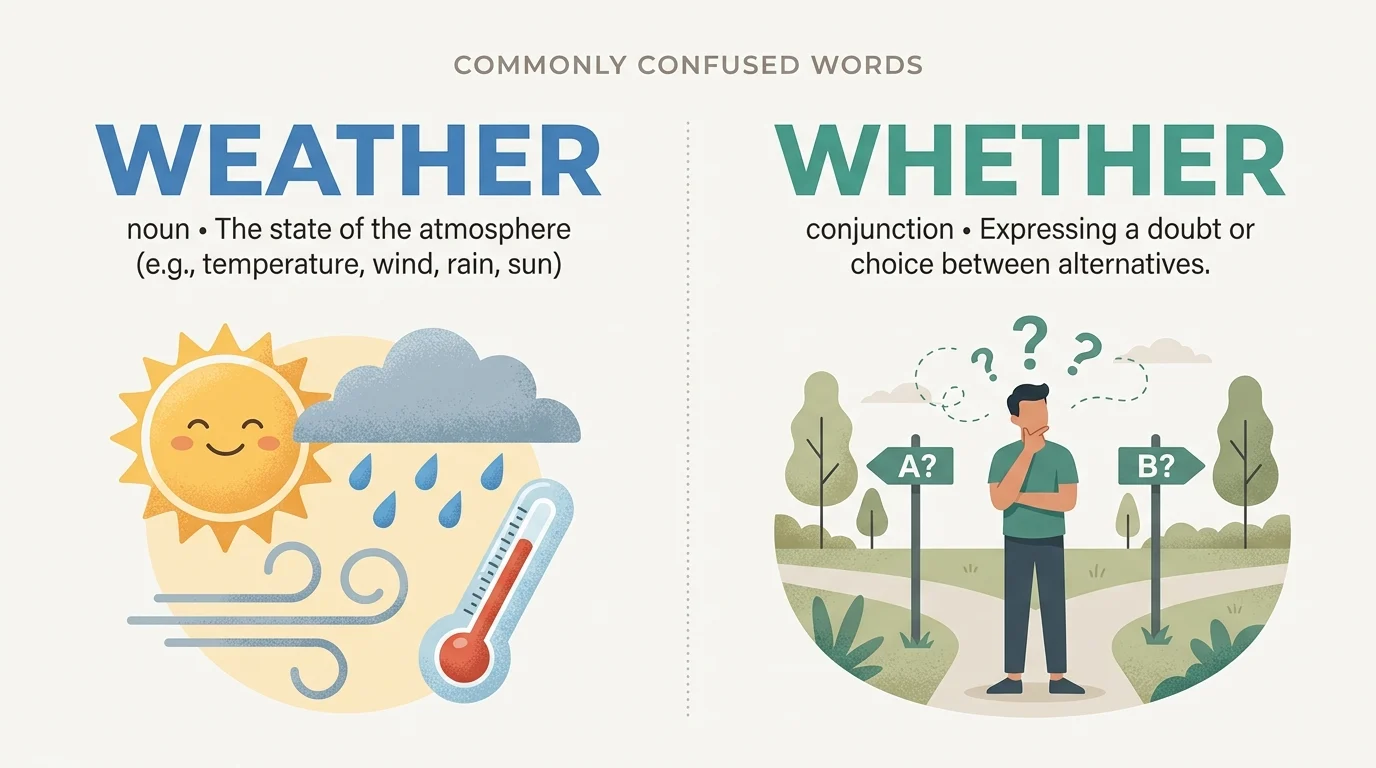
Quick Answer: Weather vs whether comes down to meaning and usage. Weather refers to outdoor conditions, such as rain, sunshine, wind, and temperature. Whether introduces a choice, possibility, or uncertainty. Although these words sound alike, they serve different purposes in a sentence. Understanding their meanings helps you avoid common spelling and grammar mistakes.
Have you ever wondered whether to write weather or whether? You are not alone. These words sound almost identical, so even confident English writers sometimes mix them up. However, their meanings and uses are completely different.
The word weather describes conditions in the atmosphere, including rain, snow, sunshine, and wind. In contrast, whether helps express a choice, doubt, or possibility. For example, you might check the weather before leaving home, but you might wonder whether it will rain later.
Because both words sound the same, pronunciation alone will not help you choose the correct spelling. Instead, you need to understand the meaning of your sentence. This guide explains the difference between weather and whether, provides simple examples, and shares easy tricks to help you remember which word to use.
What Does Weather Mean?
Weather is a noun that describes the condition of the atmosphere at a particular time and place. It includes temperature, rain, snow, sunshine, wind, and storms.
Examples of Weather in Sentences
- The weather is sunny today.
- We canceled the picnic because of the bad weather.
- Cold weather makes me want to stay indoors.
- Check the weather before planning your trip.
- The weather changed suddenly in the afternoon.
Easy tip: If your sentence discusses rain, sunshine, temperature, or outdoor conditions, use weather.
Weather can also be a verb, especially when describing how something withstands exposure to the elements. For example, “The wooden fence has weathered many storms.”
What Does Whether Mean?
Whether is a conjunction that introduces alternatives, choices, or uncertainty. It often appears when someone is considering two possibilities or does not know what will happen.
Examples of Whether in Sentences
- I don’t know whether she will attend the meeting.
- We must decide whether to stay or leave.
- He asked whether I needed help.
- She wondered whether it would rain.
- Whether you agree or disagree, please listen carefully.
Easy tip: If your sentence expresses a choice, doubt, or possibility, use whether.
You can often find whether near words such as know, decide, ask, wonder, and uncertain. These words frequently introduce questions or choices.
Weather vs Whether: Key Differences
| Feature | Weather | Whether |
|---|---|---|
| Meaning | Atmospheric conditions | Choice or possibility |
| Part of speech | Usually a noun; sometimes a verb | Conjunction |
| Common context | Rain, sunshine, wind, temperature | Decisions, doubts, alternatives |
| Example | The weather is cold. | I wonder whether it is cold. |
| Memory trick | Think of a forecast | Think of a choice |
The simplest way to remember the difference is to connect weather with the forecast and whether with a decision.
How to Remember Weather vs Whether
These simple tricks can help you choose the correct word every time.
1. Think About the Forecast
If you can replace the word with rain, sunshine, or atmospheric conditions, choose weather.
Example: “The weather looks pleasant today.”
2. Think About a Choice
If your sentence involves uncertainty or alternatives, choose whether.
Example: “I can’t decide whether to travel today.”
3. Try the Substitution Test
Replace the word with a related phrase to check its meaning.
- “The ___ is getting colder.” The sentence refers to atmospheric conditions, so use weather.
- “She asked ___ I was ready.” The sentence introduces an indirect question, so use whether.
Although this trick works in many situations, always consider the full sentence.
Common Mistakes to Avoid
Incorrect: I don’t know weather he is coming.
Correct: I don’t know whether he is coming.
Why? The sentence expresses uncertainty about someone’s arrival.
Incorrect: The whether is beautiful today.
Correct: The weather is beautiful today.
Why? The sentence describes outdoor conditions.
Incorrect: We need to check whether before leaving.
Correct: We need to check the weather before leaving.
Why? The sentence refers to the atmospheric forecast.
Remember, weather and whether are homophones, meaning they sound alike but have different meanings and spellings.
Practice: Weather or Whether?
Choose the correct word for each sentence.
- I wonder ___ they will arrive on time.
- The ___ forecast predicts heavy rain.
- She couldn’t decide ___ to buy the blue dress.
- The cold ___ affected our travel plans.
- Please tell me ___ you received my message.
Answers:
- Whether
- Weather
- Whether
- Weather
- Whether
Frequently Asked Questions
1. What is the main difference between weather and whether?
Weather describes atmospheric conditions, while whether introduces a choice, possibility, or uncertainty.
2. Are weather and whether pronounced the same?
Yes. In most English accents, they are homophones and sound alike, even though their meanings differ.
3. How do you use whether in a sentence?
Use whether to introduce uncertainty or alternatives. For example, “I don’t know whether he is available.”
4. Can weather be used as a verb?
Yes. For example, “The house must weather the storm.” It can also mean to endure a difficult situation, as in “She weathered the criticism.”
5. Is it “whether or not” or “weather or not”?
The correct phrase is whether or not. It expresses a choice or possibility, as in “Whether or not it rains, we will go.”
6. What does “under the weather” mean?
“Under the weather” is an idiom that means feeling ill or unwell. For example, “I’m feeling under the weather today.”
7. Can I start a sentence with whether?
Yes. For example, “Whether we win or lose, we will learn something.” Here, whether introduces alternatives.
8. Why do people confuse weather and whether?
People often confuse them because they sound the same. However, their meanings differ, so checking the context helps you select the correct spelling.
Conclusion
The difference between weather and whether is simple once you understand their meanings. Use weather when discussing atmospheric conditions, such as rain, wind, or sunshine. Use whether when expressing a choice, possibility, or uncertainty. With regular practice and the simple memory tricks in this guide, you can avoid this common English mistake and write with greater confidence.
6 thoughts on “Weather vs Whether: What’s the Difference? Meaning, Examples & Easy Tips”