
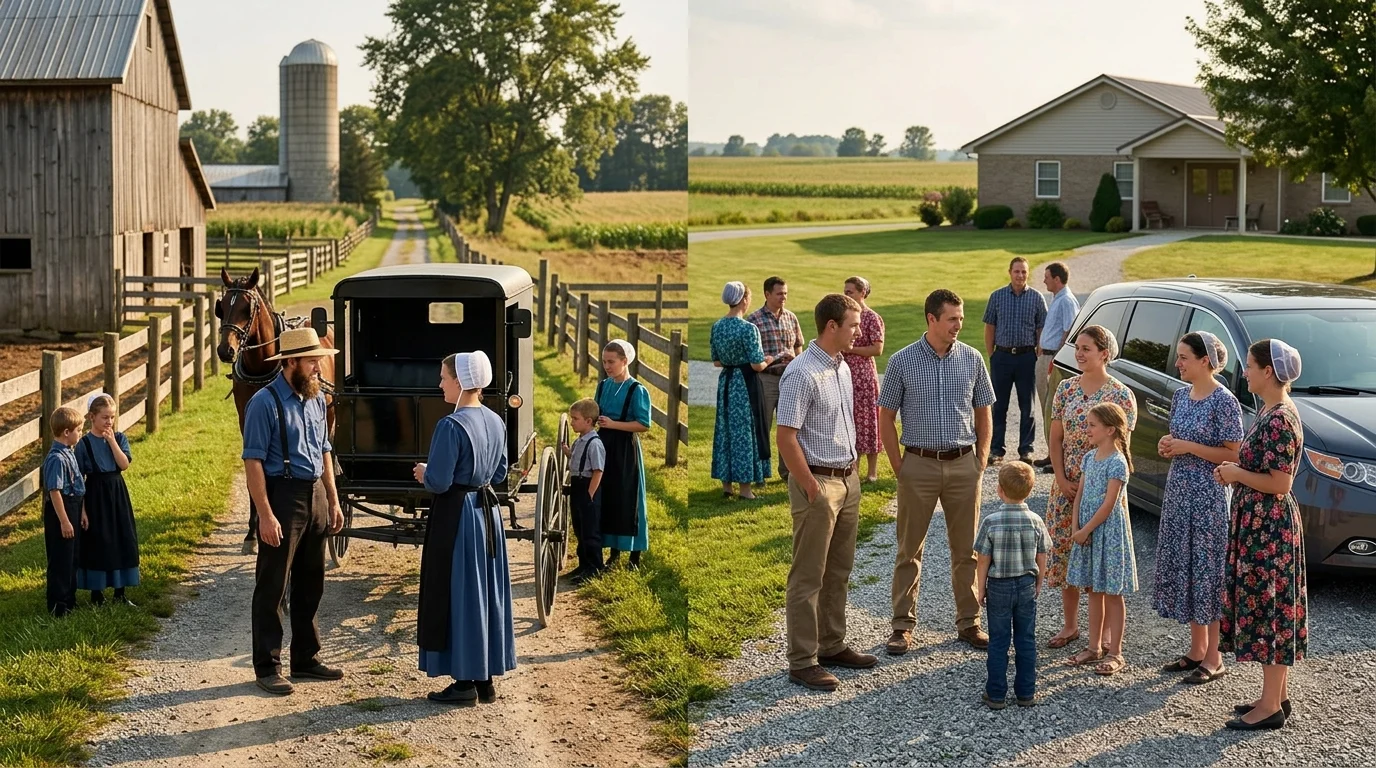
Quick Answer: Mennonites and Amish are Christian groups with shared roots in the Anabaptist movement. They emphasize faith, community, and peaceful living, but they differ in how they approach technology, clothing, transportation, education, and interaction with modern society. Amish communities generally follow stricter traditional practices, while Mennonite communities range from conservative groups to modern congregations.
Mennonites and Amish are often confused because they share similar religious beliefs, historical roots, and values. Both groups emphasize Christian faith, family, community, humility, and peaceful living. In some communities, their traditional clothing and rural lifestyles can also look remarkably similar.
However, Mennonites and Amish are not the same group. Their differences developed over time, particularly in how they understood church discipline and separation from the outside world. Today, these differences are especially visible in their use of technology, transportation, education, and everyday customs.
One important point is that neither group follows a single lifestyle. Some Mennonites live in cities, use modern technology, and attend universities. Others maintain traditional clothing and strict limits on technology. Similarly, Amish communities differ in how they apply certain customs.
In this guide, you will learn the seven main differences between Mennonites and Amish, including their beliefs, clothing, transportation, education, and daily lives. You will also discover what these communities have in common and why people often mistake one for the other.
1. Mennonites vs Amish: Historical Origins
Both groups trace their roots to the Anabaptist movement that developed in Europe during the Protestant Reformation in the 16th century. Anabaptists emphasized believer’s baptism, meaning people should choose baptism after professing their faith rather than receiving it as infants.
Mennonites take their name from Menno Simons, a former Dutch Catholic priest who became an influential Anabaptist leader.
The Amish emerged as a distinct group in 1693, when followers of Jakob Ammann separated from other Swiss Anabaptists over disagreements about church discipline and the strictness of religious practices.
Although the groups developed separately, they retained several shared Christian values, including community responsibility, humility, and peace.
2. Religious Beliefs and Practices
Mennonites and Amish share important Christian beliefs, but their religious practices can differ.
Mennonites: Many Mennonite churches emphasize following Jesus, helping others, reconciliation, and peaceful living. Their worship practices and church structures vary widely. Some congregations follow traditional customs, while others resemble mainstream Protestant churches.
Amish: Amish communities generally place strong emphasis on humility, obedience to church teachings, family life, and maintaining a close religious community. Local church rules, often called the Ordnung, guide many aspects of daily life.
Both groups have traditions of Christian pacifism, although individual churches and communities may interpret and practice their beliefs differently.
3. Clothing and Appearance
Clothing is one of the most noticeable differences between some Mennonite and Amish communities.
Traditional Amish communities often wear plain clothing designed to discourage pride and excessive attention to personal appearance. Women commonly wear modest dresses and head coverings, while men may wear plain shirts, trousers, and beards after marriage.
Mennonite clothing varies considerably. Some conservative Mennonite groups wear plain dresses, head coverings, and modest clothing. Other Mennonites dress much like people in the wider community.
Therefore, traditional clothing can help identify some groups, but it is not a reliable way to distinguish every Mennonite from every Amish person.
4. Technology and Modern Conveniences
Technology is another major difference in the Mennonites vs Amish comparison.
Many Old Order Amish communities limit the use of modern technologies to protect their religious values, family relationships, and community life. Depending on the community, restrictions may apply to household electricity, television, internet access, and personal telephones.
Mennonite communities have a broader range of practices. Many use smartphones, computers, cars, and modern household appliances. However, conservative Mennonite groups may also restrict certain technologies.
Neither group necessarily rejects technology simply because it is modern. In traditional communities, decisions often depend on whether a particular tool fits the group’s values and rules.
5. Transportation and Daily Life
Transportation is a visible difference between traditional Amish communities and many Mennonite communities.
Old Order Amish people are widely known for using horse drawn buggies instead of driving personal automobiles. Some may use other forms of transportation when necessary, depending on local rules.
Many Mennonites drive cars, use public transportation, and travel for work or education. However, some Old Order Mennonite communities also use horse drawn buggies or place restrictions on vehicles.
Daily life varies as well. Some Amish families work in farming, construction, woodworking, or family businesses. Mennonites work in many fields, including agriculture, education, healthcare, business, and technology.
It is inaccurate to assume that every Amish person is a farmer or that every Mennonite lives a modern urban lifestyle.
6. Education and Career Choices
Education practices differ between the two groups, particularly among traditional communities.
Many Old Order Amish children attend community schools and typically complete formal education around the eighth grade. Their education emphasizes basic academic skills, practical knowledge, and preparation for community life.
Mennonite educational practices vary widely. Some traditional groups favor local schooling and practical training, while many other Mennonites attend high school, college, university, or professional programs.
Career choices also differ according to community expectations. Amish adults may work in farming, skilled trades, and family businesses. Mennonites pursue a wide range of careers, including professions that require advanced education.
These are general patterns, not universal rules. Individual communities make their own decisions about education and employment.
7. Community Life and Interaction With Society
Amish communities generally place a strong emphasis on preserving their distinct religious identity and maintaining boundaries between their community and the wider society. Worship often takes place in members’ homes, depending on the group.
Mennonite communities vary in how closely they separate themselves from mainstream society. Many participate actively in public life, higher education, charitable work, peacebuilding, and community service. Others maintain more traditional lifestyles.
Both groups value family connections, mutual support, and helping community members. However, they may express these values through different customs and organizational structures.
Mennonites vs Amish: Comparison Table
| Feature | Mennonites | Amish |
|---|---|---|
| Religious background | Anabaptist Christianity | Anabaptist Christianity |
| Technology | Ranges from modern to restricted | Often more restricted in traditional communities |
| Transportation | Many use cars | Old Order communities generally use horse drawn buggies |
| Clothing | Modern or plain, depending on group | Often distinctive plain clothing |
| Education | Ranges from local schooling to university | Traditional schooling often ends around eighth grade |
| Worship | Often in church buildings | Often in homes among Old Order groups |
| Interaction with society | Ranges from broad participation to separation | Traditional groups emphasize separation from mainstream culture |
Common Misconceptions
Misconception 1: All Mennonites dress plainly.
Many do not. Clothing depends on the particular congregation and tradition.
Misconception 2: Amish people reject every modern invention.
Amish communities make decisions about technology according to their local rules. Some technologies may be permitted for specific purposes.
Misconception 3: Mennonites and Amish follow completely different religions.
They share Anabaptist roots and several core Christian commitments, although their traditions have developed differently.
Misconception 4: All Amish and Mennonite communities follow identical rules.
Both groups include communities with different practices, so generalizations do not apply to everyone.
Frequently Asked Questions
Are Mennonites and Amish the same religion?
They are distinct Christian groups with shared roots in the Anabaptist movement. They share several beliefs but differ in religious customs and community practices.
Why did the Amish separate from the Mennonites?
The Amish emerged from a division in 1693 involving disagreements about church discipline and the strictness of religious practices.
Can Mennonites use phones and computers?
Many can and do. However, conservative Mennonite communities may place restrictions on certain devices and technologies.
Do Amish people drive cars?
Old Order Amish communities generally do not drive personal automobiles. Some may use hired drivers or other transportation when needed, subject to community customs.
Do Mennonites wear the same clothes as Amish people?
Some conservative Mennonites wear plain clothing similar to Amish clothing. Many other Mennonites wear contemporary clothing.
Do Mennonites and Amish speak the same language?
Some traditional communities speak Pennsylvania German or related German dialects. Many Mennonites and Amish also speak English, and language use varies by community.
Which group is more traditional?
Old Order Amish communities are often more restrictive regarding technology and separation from mainstream society. However, some Mennonite communities also maintain strict traditional practices.
Do Mennonites and Amish believe in peace?
Both traditions have strong historical commitments to Christian nonviolence and peace. The ways these beliefs are expressed may vary among communities.
Conclusion
The main difference between Mennonites and Amish is how their communities apply shared Christian beliefs to everyday life. Both groups have Anabaptist roots and value faith, humility, family, community, and peace. However, they have developed different traditions regarding technology, clothing, transportation, education, and interaction with wider society.
Traditional Amish communities generally maintain stricter limits on modern technology and emphasize separation from mainstream culture. Mennonite communities, on the other hand, range from conservative groups with plain clothing and restricted technology to congregations that participate fully in modern society.
Still, these differences should not be treated as absolute rules. Practices vary within both groups, and not every person follows the same customs.
Understanding their shared history and diverse lifestyles provides a more accurate picture than relying on stereotypes. Ultimately, Mennonites and Amish are related but distinct Christian traditions, each shaped by its own interpretation of faith, community, and daily living.