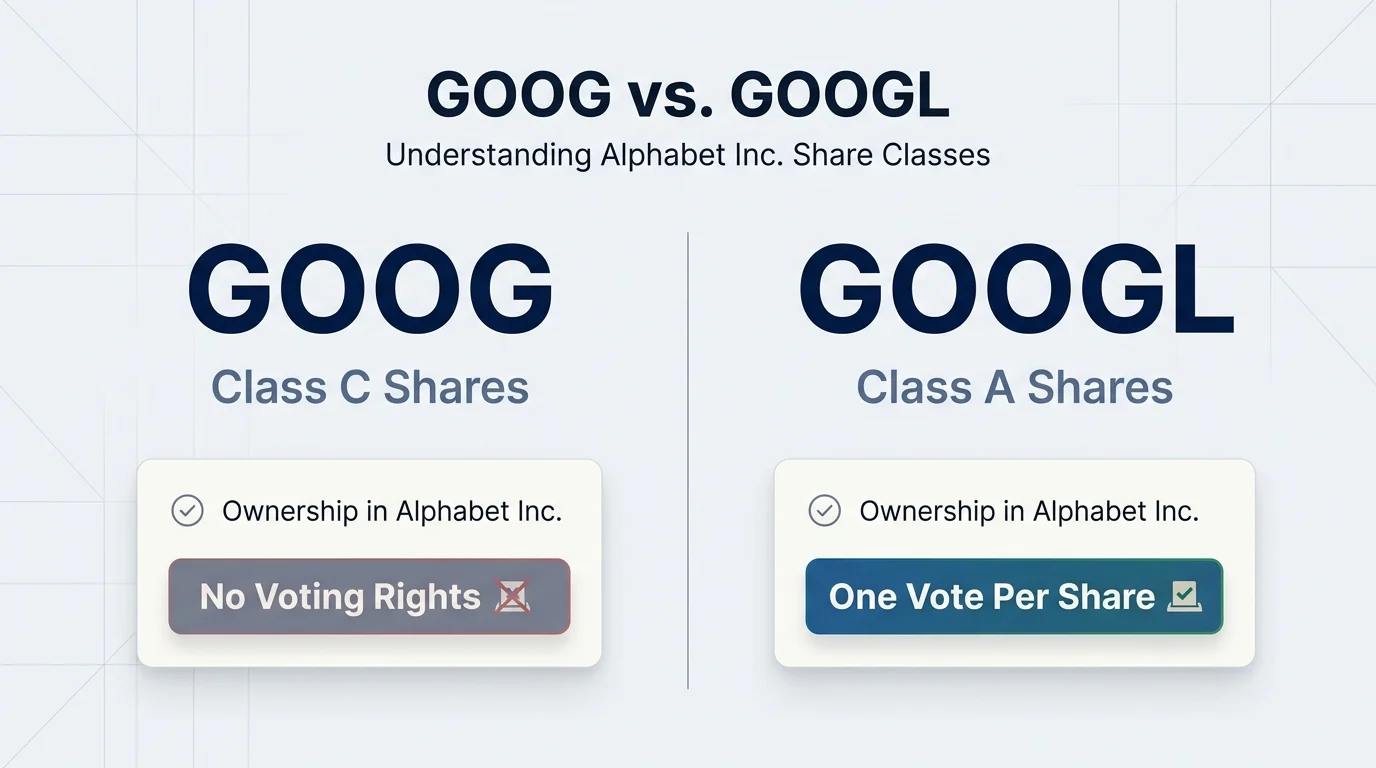
Quick Answer: GOOG and GOOGL are two stock ticker symbols for Alphabet Inc., the parent company of Google. GOOG represents Class C shares, which generally have no voting rights, while GOOGL represents Class A shares, which generally provide one vote per share. Both represent ownership in the same company, but their voting rights differ.
If you have searched for Google stock, you may have noticed two similar ticker symbols: GOOG and GOOGL. At first glance, they may look like different spellings of the same name. However, they represent two different classes of shares in Alphabet Inc., the company that owns Google.
Understanding the difference between GOOG and GOOGL can help you make sense of stock listings, financial news, and investment discussions. Both share classes give investors exposure to Alphabet, but they do not provide exactly the same shareholder rights.
The main difference is voting power. GOOG represents Class C shares, which generally do not carry voting rights. GOOGL represents Class A shares, which generally provide one vote per share. Their market prices can differ slightly, although their performance often follows similar patterns because both are tied to the same business.
In this guide, you will learn what GOOG and GOOGL mean, how their share classes compare, and what investors should understand before evaluating either stock.
GOOG vs GOOGL: Quick Answer
The difference between GOOG and GOOGL comes down primarily to shareholder voting rights.
- GOOG: Alphabet Class C shares with no ordinary voting rights.
- GOOGL: Alphabet Class A shares with one vote per share.
- Company: Both represent ownership in Alphabet Inc.
- Business exposure: Both are linked to Alphabet’s overall financial performance.
Neither ticker is simply a misspelling of the other. They identify different share classes listed on the stock market.
What Does GOOG Mean?
GOOG is the stock ticker symbol for Alphabet Inc.’s Class C capital stock. A ticker symbol is a short code used to identify a publicly traded security.
Class C shares generally do not provide ordinary voting rights at shareholder meetings. This means holders typically cannot vote on corporate matters through these shares in the same way that holders of voting shares can.
However, Class C shareholders still own an interest in Alphabet. Their investment value can rise or fall with the market price of the shares and the company’s financial performance.
For example, an investor researching GOOG is looking at Alphabet’s Class C stock rather than buying a separate company called Google.
What Does GOOGL Mean?
GOOGL is the ticker symbol for Alphabet Inc.’s Class A capital stock. These shares generally carry one vote per share, allowing shareholders to participate in certain corporate voting decisions.
Like GOOG, GOOGL represents an ownership interest in Alphabet. Its value is influenced by factors such as advertising revenue, cloud computing growth, business costs, competition, and investor expectations.
The main distinction is that GOOGL provides voting rights that GOOG generally does not.
GOOG vs GOOGL: Key Differences
| Feature | GOOG | GOOGL |
|---|---|---|
| Company | Alphabet Inc. | Alphabet Inc. |
| Share class | Class C | Class A |
| Ordinary voting rights | Generally none | Generally one vote per share |
| Ownership interest | Yes | Yes |
| Business exposure | Alphabet | Alphabet |
| Market price | Changes with market demand | Changes with market demand |
Shareholder rights can depend on the company’s governing documents and applicable rules, so investors should consult Alphabet’s official disclosures for precise details.
Why Does Alphabet Have Two Stock Tickers?
Alphabet uses different share classes to separate economic ownership from voting control.
This structure allows investors to own shares in the company without necessarily receiving the same level of influence over corporate decisions. Alphabet also has Class B shares, which generally carry greater voting power and are not publicly traded on the stock market.
The distinction between share classes is important because owning a company and controlling its decisions are not always the same thing.
Are GOOG and GOOGL Prices the Same?
No. GOOG and GOOGL can trade at different prices, although their prices are often close.
Both share classes are connected to the same underlying business. Consequently, developments affecting Alphabet, such as changes in advertising revenue, artificial intelligence investments, regulatory decisions, or cloud computing growth, can affect both stocks.
Small price differences may reflect market supply and demand, the value investors place on voting rights, and other market factors. The price relationship can change over time.
Investors should compare current prices rather than assume that one ticker is always cheaper.
Which Is Better: GOOG or GOOGL?
There is no universally better choice for every investor. The right comparison depends on the investor’s goals, preferences, costs, and circumstances.
GOOGL may appeal to someone who values ordinary shareholder voting rights. GOOG may appeal to someone who does not consider those rights important, particularly if its price offers a more attractive entry point.
However, voting rights are only one part of an investment decision. Investors should also consider valuation, business risks, portfolio diversification, transaction costs, and their investment time horizon.
Past performance does not guarantee future results, and a lower share price does not automatically mean a stock is better value.
Common Mistakes to Avoid
| Mistake | Correct explanation |
|---|---|
| Treating GOOG and GOOGL as different companies | Both represent Alphabet Inc. |
| Assuming GOOG is a misspelling | GOOG is a legitimate stock ticker. |
| Assuming GOOGL guarantees better returns | Voting rights do not guarantee higher returns. |
| Believing both stocks always have identical prices | Their market prices can differ. |
| Confusing Google with Alphabet | Alphabet is the parent company that owns Google. |
Frequently Asked Questions
Is GOOG the same as GOOGL?
They represent shares in the same company, Alphabet Inc., but belong to different share classes. The primary distinction is their voting rights.
What is the difference between GOOG and GOOGL?
GOOG represents Class C shares that generally have no voting rights. GOOGL represents Class A shares that generally carry one vote per share.
Does GOOGL have more voting power than GOOG?
Yes. Class A GOOGL shares generally provide one vote per share, while Class C GOOG shares generally have no ordinary voting rights.
Are GOOG and GOOGL both Google stocks?
They are both Alphabet stocks. Alphabet owns Google and several other businesses, so the ticker symbols identify ownership in the parent company rather than separate Google companies.
Can GOOG be more expensive than GOOGL?
Yes. Either share class can trade at a higher price at a given time. Their relative prices depend on market conditions and investor demand.
Which stock is better for beginners?
Neither is automatically better for beginners. Investors should understand the share class, compare valuations and risks, and choose according to their financial goals.
Why does Alphabet use different share classes?
The structure allows different levels of shareholder voting power while providing investors with ownership interests in the company.
Is GOOG a spelling mistake for Google?
No. GOOG is a legitimate stock ticker symbol. GOOGL is another legitimate ticker symbol representing a different class of Alphabet shares.
Conclusion
The difference between GOOG and GOOGL is mainly about voting rights, not ownership of separate businesses. GOOG represents Alphabet’s Class C shares, which generally have no ordinary voting rights. GOOGL represents Class A shares, which generally provide one vote per share.
Both share classes give investors exposure to Alphabet’s business and can respond to similar company news and financial developments. However, their market prices may differ, and voting rights may matter to some shareholders more than others.
Before comparing the two, confirm the current share prices, understand the rights attached to each class, and review Alphabet’s official investor disclosures. The best choice depends on your goals and circumstances rather than the ticker symbol alone.