
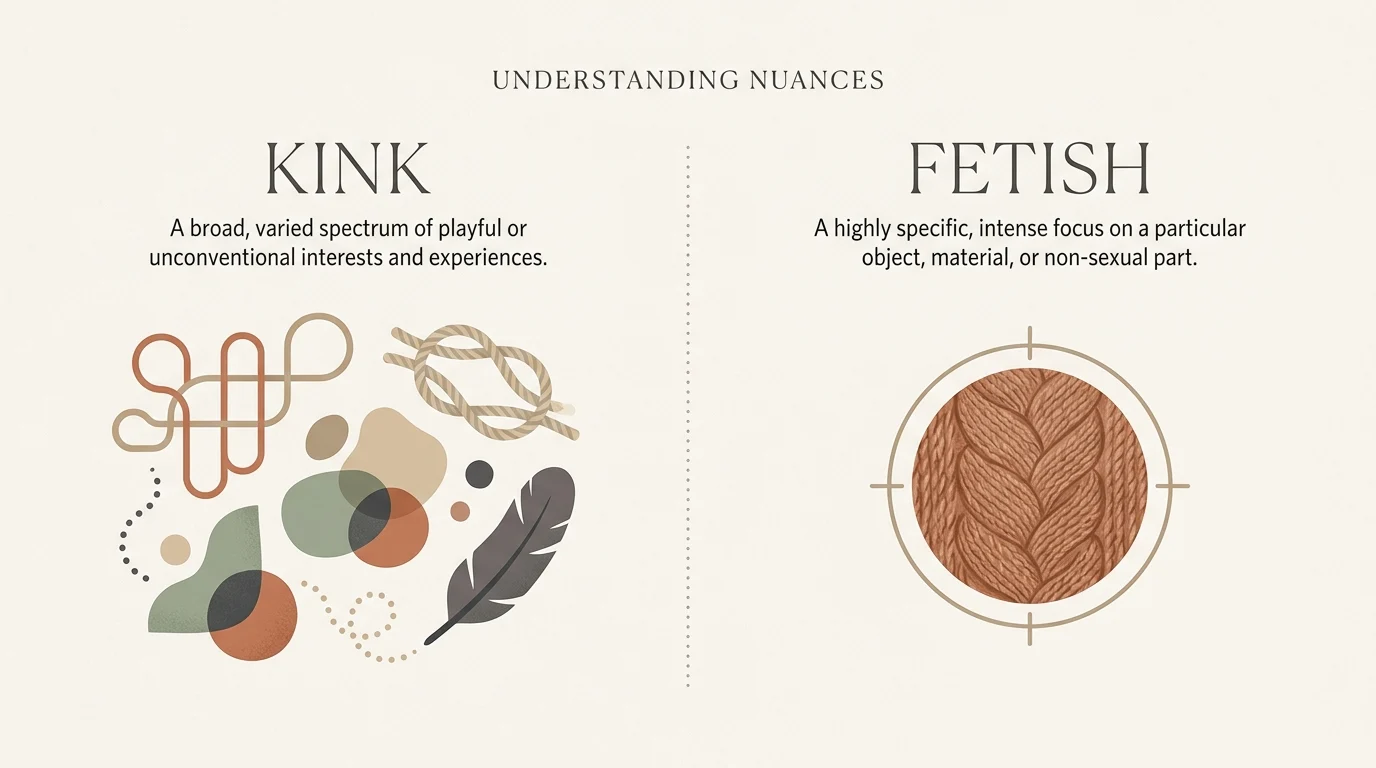
Quick Answer: A kink is a sexual interest or preference that falls outside what someone considers conventional, while a fetish is a specific object, body part, or situation that plays an important role in sexual arousal. The terms can overlap, but they are not identical. Neither automatically indicates a problem when adults explore their interests consensually and safely.
The terms kink and fetish are often used interchangeably, but they do not always mean the same thing. Both describe aspects of sexual interests and preferences, yet they can differ in their focus, meaning, and role in a person’s intimate life. Understanding the distinction can make conversations about sexuality clearer and help people avoid common misconceptions.
A kink generally refers to a particular preference, activity, or experience that someone finds exciting. A fetish usually involves a specific object, body part, or situation that has a strong connection to sexual arousal. However, the boundaries between these terms are not always strict, and people may use them differently depending on their experiences and preferences.
In this guide, you will learn what kink and fetish mean, how they differ, when their meanings overlap, and how to use each term correctly. You will also discover common myths and answers to frequently asked questions.
Kink vs Fetish: Quick Answer
The simplest difference is that a kink is a broad category of sexual interests, while a fetish usually describes a more specific focus associated with arousal.
For example, someone might describe a particular consensual activity as a kink. Another person might have a fetish involving a particular material or object. A fetish can also be part of someone’s broader kink interests.
The exact meaning depends on context because everyday conversations do not always follow strict clinical definitions.
What Does Kink Mean?
A kink is a sexual preference, interest, or activity that someone considers outside conventional sexual expectations. The term is broad and can describe many different interests, including particular scenarios, sensations, roles, or dynamics.
People may explore kinks for different reasons. Some enjoy novelty, while others appreciate the emotional connection, trust, or communication involved in exploring a shared interest.
Examples of a Kink
A person might describe the following as kinks:
- Enjoying a particular role or character during consensual intimacy.
- Preferring certain sensations or forms of sensory stimulation.
- Enjoying a specific relationship dynamic that all participants freely agree to explore.
These examples illustrate how broad the word kink can be. A kink does not necessarily involve a specific object, and having one does not automatically mean someone has a fetish.
What Does Fetish Mean?
A fetish generally refers to a specific object, body part, material, or situation that has a significant connection to a person’s sexual arousal. The focus is usually narrower than the broad range of interests described by the word kink.
For some people, a particular item or feature adds to their arousal. For others, it may play a central role in their sexual interests. The importance of that focus varies from person to person.
Examples of a Fetish
Examples may include a strong sexual interest in a particular material, such as leather, or a specific object or body feature.
The presence of a fetish does not automatically indicate a mental health condition. In clinical contexts, a fetishistic interest is different from a fetishistic disorder, which involves additional criteria such as significant distress or impairment. A qualified mental health professional can assess concerns when they affect someone’s well being.
Kink vs Fetish: Key Differences
| Feature | Kink | Fetish |
|---|---|---|
| Meaning | A broad sexual interest or preference | A specific focus connected to arousal |
| Scope | Can include activities, sensations, roles, or dynamics | Often centers on an object, body part, material, or situation |
| Focus | May involve an experience or activity | Usually involves a particular stimulus or focus |
| Overlap | Can include interests that someone also describes as fetishes | Can be one part of a person’s broader kink interests |
| Is it automatically a problem? | No | No |
The main distinction is the scope of each term. Kink is generally broader, while fetish is often more specific. However, everyday usage can overlap, so these definitions should not be treated as rigid rules.
Are Kink and Fetish the Same Thing?
No, although they can overlap. Someone may have a kink that does not involve a fetish, a fetish that they do not describe as a kink, or interests that fit both descriptions.
For example, a person who enjoys a particular consensual role playing scenario might call it a kink. Someone with a strong arousal response to a particular material might call that interest a fetish. Depending on how the person understands their preferences, either interest could also fall under the broader idea of kink.
The labels are useful for communication, but they do not define a person’s identity or determine whether their interests are healthy.
When Should You Use Kink or Fetish?
Choose the word that best describes the situation.
Use kink when discussing a broad sexual preference, activity, or dynamic. Use fetish when the focus is a particular object, body part, material, or situation associated with arousal.
For instance, you might say, “They discussed their kinks before deciding what they both felt comfortable exploring.” You might also say, “That material is associated with their fetish.”
In either situation, respectful communication matters more than choosing a label. Partners should discuss boundaries, consent, and expectations without making assumptions about one another.
Common Misconceptions About Kinks and Fetishes
| Misconception | What is more accurate |
|---|---|
| Every kink is a fetish. | Kink is a broader term that covers many kinds of interests. |
| A fetish always involves an object. | Fetishes can involve objects, body parts, materials, or situations. |
| Having a fetish means someone has a disorder. | An interest alone does not establish a mental health disorder. |
| Kinks are always unusual or harmful. | Interests vary, and consensual preferences are not automatically harmful. |
| These terms have perfectly fixed meanings. | Their everyday meanings can overlap and vary by person. |
A simple rule to remember: Think of kink as the broader category and fetish as a more specific focus associated with arousal. This distinction is helpful, although it does not cover every person’s experience.
Frequently Asked Questions
1. Is a kink the same as a fetish?
Not exactly. A kink is a broad sexual interest or preference, while a fetish generally involves a specific focus that contributes significantly to arousal. The terms can overlap.
2. Can someone have both a kink and a fetish?
Yes. A person can have several kinks and also have a fetish. One interest may fit both descriptions, depending on its nature and the person’s own terminology.
3. Is having a fetish normal?
Fetishistic interests vary among individuals. Having a fetish does not automatically indicate a problem. Distress, impaired daily functioning, or issues involving consent deserve appropriate attention.
4. Can a kink become a fetish?
The terms describe different aspects of sexual interests rather than fixed stages. Someone may develop a stronger interest in a particular stimulus and choose to describe it as a fetish.
5. Does a fetish mean someone cannot become aroused without it?
Not necessarily. The importance of a fetish varies. For some people it is an additional preference, while for others it may play a central role in arousal.
6. Should people discuss kinks and fetishes with their partners?
Open, respectful communication can help partners understand each other’s preferences and boundaries. Any activity should involve informed, voluntary consent from everyone involved.
7. When should someone seek professional support?
Consider speaking with a qualified mental health professional if an interest causes significant distress, interferes with everyday life, or creates concerns about safety or consent.
Conclusion
Understanding the difference between kink and fetish starts with recognizing that the terms describe related but distinct aspects of sexual interests. A kink is a broad preference, activity, or dynamic, while a fetish usually centers on a specific object, body part, material, or situation associated with arousal.
Although their meanings can overlap, the distinction helps people communicate more clearly. Neither term automatically suggests that someone has a problem, and a sexual interest alone is not enough to establish a mental health diagnosis. Consent, personal boundaries, safety, and mutual respect are more important than the label someone chooses.
When deciding whether to use kink or fetish, consider the focus of the interest. Choose kink for a broader preference or experience and fetish for a more specific focus associated with arousal. Remember that individual experiences differ, so these words should support understanding rather than create stereotypes.