
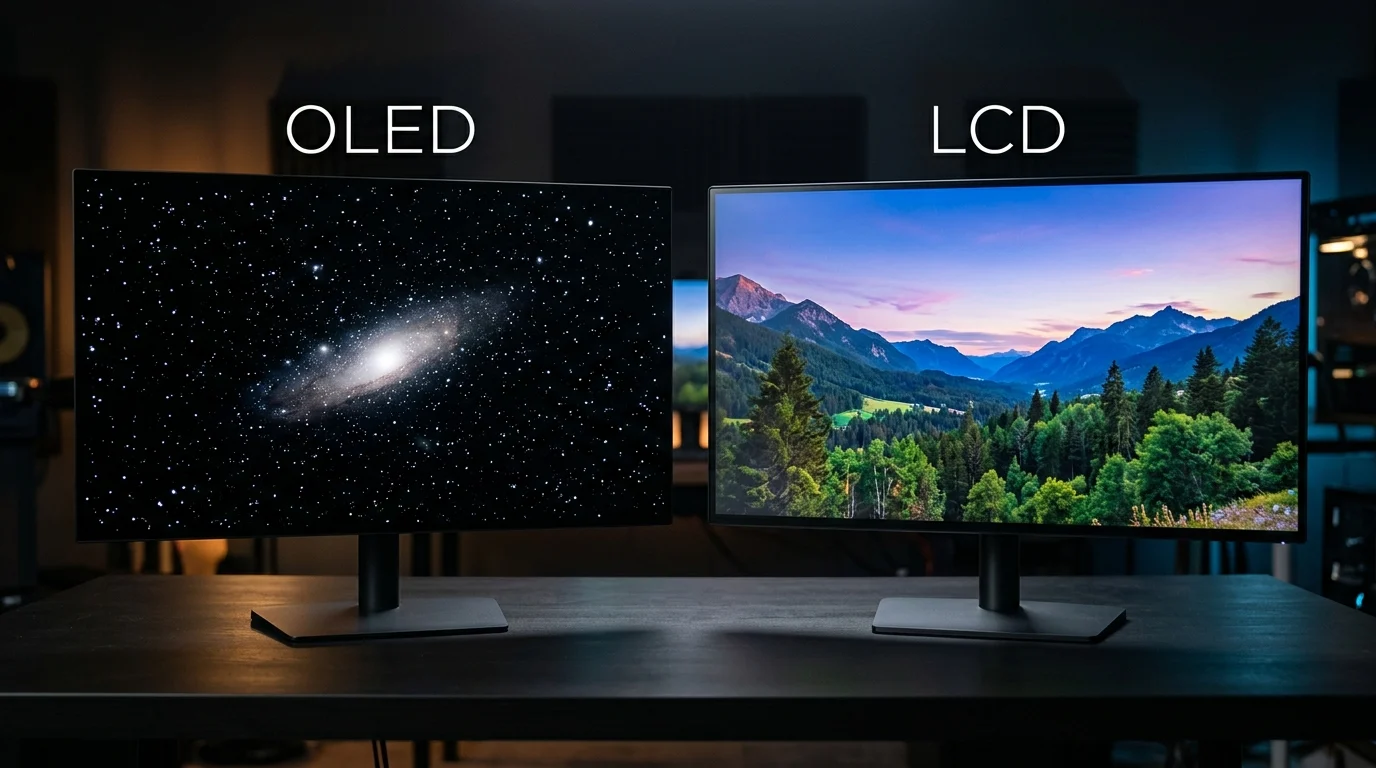
Quick Answer: OLED vs LCD comes down to how each display produces images. OLED screens use self lighting pixels that can turn off individually, delivering deeper blacks, high contrast, and excellent viewing angles. LCD screens use a backlight, often making them more affordable and available in many sizes. The better option depends on your budget, viewing habits, and device needs.
When buying a television, laptop, smartphone, or monitor, you may find yourself comparing OLED vs LCD displays. Both technologies produce clear, colorful images, but they work differently. These differences can affect picture quality, brightness, power consumption, price, and long term performance.
OLED displays are known for their deep blacks and strong contrast because each pixel produces its own light. LCD displays use a separate backlight to illuminate the screen. Many modern LCD products also include LED backlights, which is why you often see the term LED TV. Despite the name, LED TVs are generally a type of LCD display.
Neither technology is automatically the best choice for everyone. OLED can be excellent for movies, gaming, and dark rooms, while LCD can offer better value for buyers who want an affordable screen or need a display for a bright environment.
In this guide, you will learn the main differences between OLED and LCD, including picture quality, brightness, lifespan, cost, and which option may suit your needs.
OLED vs LCD: Quick Answer
OLED is usually the better choice if you want deep blacks, excellent contrast, and strong viewing angles. LCD is often a practical choice if you want a lower price, a wide range of models, or a screen suited to everyday use.
The best display depends on the specific product. Premium LCD screens can outperform some lower quality OLED displays in certain situations, especially when brightness and price matter most.
What Is an OLED Display?
OLED stands for Organic Light Emitting Diode. Unlike LCD technology, an OLED screen does not need a separate backlight. Each pixel produces its own light and can switch off completely when displaying black.
This design gives OLED displays several advantages:
- Deep blacks: Individual pixels can turn off, producing very dark areas.
- High contrast: Bright highlights can appear next to true black pixels.
- Wide viewing angles: Images often retain their quality when viewed from the side.
- Fast response times: Pixels can change quickly, which benefits gaming and fast moving content.
- Slim designs: OLED panels can be very thin because they do not require a separate backlight.
OLED screens are common in premium smartphones, televisions, and some laptops and gaming monitors.
However, OLED displays can cost more than comparable LCD models. They may also experience burn in if static images remain on screen for long periods under certain conditions.
What Is an LCD Display?
LCD stands for Liquid Crystal Display. LCD screens use liquid crystals to control how light passes through the display. A separate backlight provides the light needed to create an image.
Many modern LCD screens use LED backlighting. Manufacturers may also add technologies such as local dimming and quantum dots to improve contrast, brightness, or color reproduction.
Common advantages of LCD displays include:
- Affordable options: Many budget friendly screens use LCD technology.
- High brightness: Some LCD models work particularly well in bright rooms.
- Wide availability: LCD screens come in many sizes and price ranges.
- No OLED style burn in: LCDs do not typically suffer from the same pixel burn in mechanism as OLED displays.
LCD performance varies considerably. A basic LCD panel may have limited contrast, while a high quality model with advanced local dimming can deliver impressive picture quality.
OLED vs LCD: Key Differences
| Feature | OLED | LCD |
|---|---|---|
| Lighting | Each pixel produces its own light | Uses a separate backlight |
| Black levels | Excellent, with true black pixels | Depends on backlight and dimming |
| Contrast | Generally excellent | Varies by panel type |
| Brightness | Depends on model and screen area | Some models achieve very high brightness |
| Viewing angles | Usually wide | Vary by panel type |
| Response time | Usually very fast | Varies by panel technology |
| Burn in risk | Possible under certain usage patterns | No typical OLED style pixel burn in |
| Price | Often higher | Available from budget to premium levels |
Which Has Better Picture Quality?
OLED usually has the advantage in contrast and black levels. Since individual pixels can turn off, dark scenes in films and games can look more realistic. This is especially noticeable in a dim room.
LCD picture quality depends on its panel and backlight. Some inexpensive LCD displays show grayish blacks, particularly when viewed in darkness. However, premium LCD models with effective local dimming can achieve strong contrast and high brightness.
Color quality is not determined by display technology alone. Both OLED and LCD screens can produce accurate, vibrant colors when properly designed and calibrated.
Which Is Better for Gaming?
OLED is an excellent option for gaming because its fast pixel response can reduce visible motion blur. Its strong contrast also makes dark scenes look impressive. Many OLED gaming displays support high refresh rates, although specifications vary by model.
LCD gaming monitors can also perform very well. Some offer high refresh rates, low input lag, and excellent brightness at a lower price. They may be a sensible choice for competitive gaming or buyers who want a larger screen without spending as much.
Before choosing, compare refresh rate, response time, input lag, resolution, and connectivity rather than relying on panel type alone.
Which Lasts Longer?
Both OLED and LCD displays can last for years, but their potential problems differ.
OLED pixels can wear unevenly over time, especially when the screen repeatedly displays static elements at high brightness. This can cause burn in, where a faint image remains visible. Modern OLED displays often include protective features, but these measures do not eliminate the risk entirely.
LCD displays do not usually develop OLED style burn in. However, their backlights and other components can still degrade or fail.
Actual lifespan depends on product quality, brightness settings, usage patterns, and operating conditions.
Which Should You Buy?
Choose OLED if you prioritize movie watching, deep blacks, strong contrast, and fast pixel response. It is particularly appealing for dark rooms and high quality gaming setups.
Choose LCD if you want to save money, need a display for general office work, or prefer a screen without the typical OLED burn in concern. A bright LCD can also be a strong option for rooms with substantial ambient light.
For laptops and monitors, consider how much static content you display. For televisions, think about room lighting, viewing distance, and the type of content you watch.
Frequently Asked Questions
Is OLED better than LCD?
OLED is generally better for black levels, contrast, and pixel response. LCD may be better for budget conscious buyers and some bright viewing environments.
Is LED the same as LCD?
Not exactly. Most LED TVs are LCD TVs that use LED backlighting. OLED is a different technology that does not need a separate backlight.
Does OLED use more battery than LCD?
It depends on the content and device. OLED may use less power when showing dark images because black pixels can switch off. Bright, mostly white content can change the result.
Can OLED screens suffer from burn in?
Yes. Burn in is possible when static elements remain visible for long periods, although the risk depends on usage and the display’s protective features.
Is LCD better for bright rooms?
Some LCD displays can achieve very high brightness, making them excellent for bright rooms. However, the result depends on the specific LCD and OLED models being compared.
Which is better for watching movies?
OLED is often preferred for movies because it produces deep blacks and strong contrast, especially in dark rooms. A high quality LCD can still provide an excellent viewing experience.
Which is cheaper, OLED or LCD?
LCD screens are generally available at lower prices, although premium LCD products can be expensive. OLED models often cost more than comparable mainstream LCD options.
Is OLED worth the extra money?
OLED may be worth the extra cost if you value contrast, dark scene detail, and fast response times. If you mainly browse, work, or watch everyday content, a good LCD may offer better value.
Conclusion
The choice between OLED vs LCD depends on your priorities. OLED stands out for its deep blacks, excellent contrast, wide viewing angles, and fast pixel response. These features make it a strong option for movies, gaming, and premium displays.
LCD remains a practical alternative because it offers a broad range of prices, sizes, and brightness levels. Some advanced LCD screens deliver excellent image quality while costing less than comparable OLED models. They can also be attractive to people who frequently display static content.
Before purchasing, compare the exact models, their brightness, refresh rate, contrast, warranty, and price. OLED is often the better choice for picture quality in dark environments, while LCD can be the smarter purchase for affordability and everyday use. The best display is the one that matches your needs and budget.